



Most “best agency” lists are just affiliate roundups and copy‑pasted blurbs. They rarely tell you who is actually good for your specific stage, channel mix, and revenue target—or how to vet them.
This guide is different: it breaks down the systems, data, and proof that separate elite growth partners from everyone else, then gives you a short list of agencies (including ours) that meet those criteria in 2026.
TL;DR: Top Growth & E‑Commerce Marketing Agencies in 2026
Here’s a quick view of standout agencies across growth, e‑commerce, SEO, and generative engine optimization (GEO / AEO).
This list includes Digital Position plus other standout agencies buyers commonly compare in 2026.
| Agency | Best For | Sweet Spot Brand Stage | Core Strengths |
|---|---|---|---|
| Digital Position | E‑commerce growth for Shopify/DTC brands | $5M–$500M annual revenue | Full‑funnel growth (paid + CRO + lifecycle), content first creative strategy, GEO/AEO for AI visibility |
| NoGood | Broad growth marketing for SaaS & consumer brands | VC‑backed/enterprise | Experimentation-driven growth sprints, cross‑functional teams |
| Omniscient Digital | Content‑led SEO for B2B SaaS | B2B SaaS mid‑market | Organic growth via content, pipeline-focused SEO |
| iPullRank | Technical SEO & AI search (GEO) for complex sites | Enterprise | Relevance engineering, large‑scale content & entity work |
| Nectiv | Generative Engine Optimization (GEO) | Mid‑market & enterprise | AI search visibility strategy across ChatGPT, Perplexity, AI Overviews |
How “Best” E‑Commerce Growth Agencies Are Really Different
Most lists tell you who they like. You need to know how to tell who is actually good.
1. They Think in Systems, Not “Growth Hacks”
Top growth agencies don’t chase one‑off tricks; they build repeatable systems that connect acquisition, conversion, and retention to revenue.
The best firms share three traits:
- A documented testing framework – Clear hypothesis → test design → success threshold → rollout process.
- Channel prioritization based on unit economics – Budgets tied to LTV:CAC, payback, and contribution margin, not vanity ROAS.
- Tight feedback loops – Weekly experimentation cycles that feed learnings back into creative, targeting, and onsite experience.
How Digital Position runs growth:
We operate as an extended Chief Marketing Organization using a documented 7‑pillar system (brand foundation, tracking, website/CRO, creative engine, paid acquisition, search/organic, retention) in our Digital Position Growth Framework.
- We start by aligning on business metrics (MER, new vs. returning CAC, contribution margin targets), then map every channel activity back to those numbers.
- We run a consistent cadence of creative + channel iteration, then roll learnings into the next production cycle so “wins” become a repeatable playbook, not a one-off spike.
- We avoid channel silos. If the bottleneck is product page clarity, tracking accuracy, or offer structure, we fix that instead of trying to brute-force more ad spend.
Proof we operate at scale (company-level):
We have worked with hundreds of e-commerce brands over a decade. That volume matters because it creates real pattern recognition across tracking, creative testing, CRO, and channel mix decisions, so we are not guessing from one or two “hero” case studies.
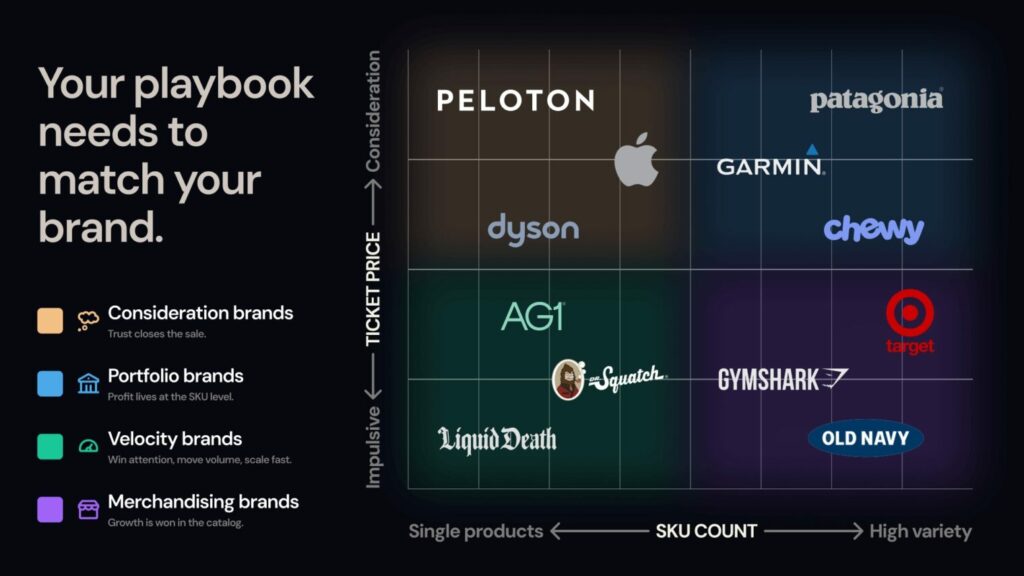
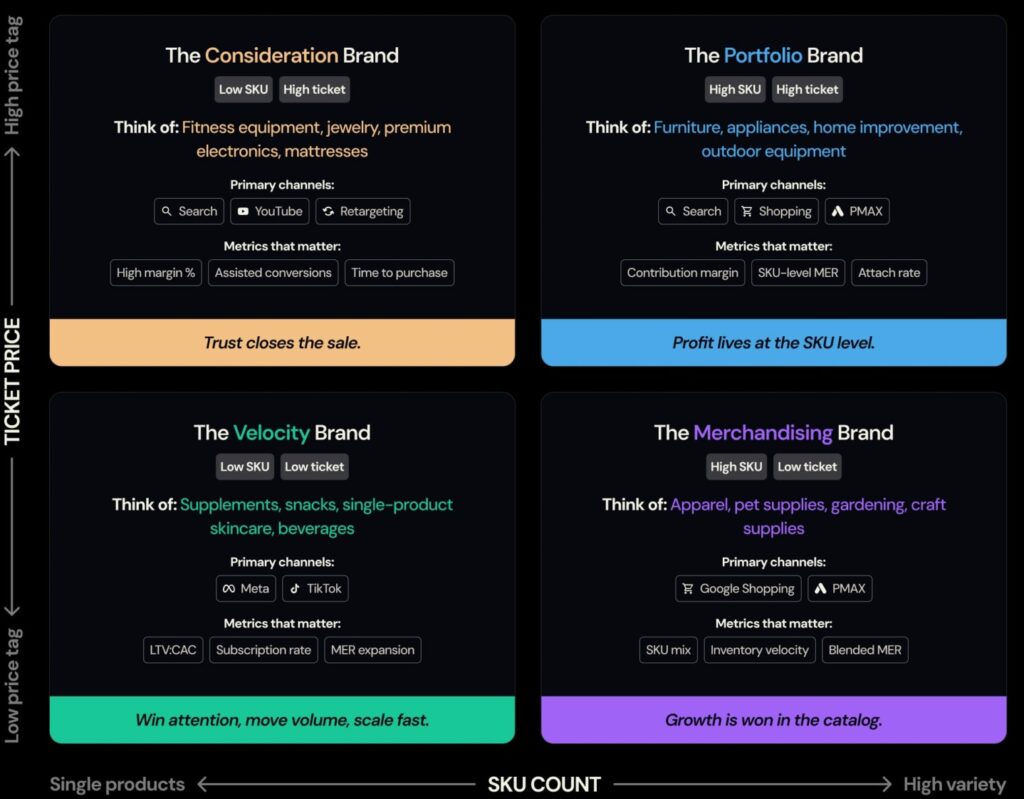
Below is a visual showing how we segment e-commerce brands so we can tailor each growth pillar to match customer behavior and profitability goals.
2. They Are Built for E‑Commerce, Not “General Digital”
In 2026, the delta between generalist digital agencies and e‑commerce specialists is huge.
- Use e‑commerce‑specific benchmarks (AOV, contribution margin, SKU mix, return rates).
- Know how to dial media and CRO around inventory, merchandising, and product economics.
- Integrate shop data (Shopify, Klaviyo, Triple Whale/Northbeam) into every decision.
If an agency can’t answer “What types of content should I be making to rank on LLMs, top line growth, or increased conversions” you’re going to fall behind.
3. They Already Operate in an AI/LLM‑First World
With AI search (Google AI Overviews, ChatGPT, Perplexity, etc.) now influencing discovery, the best agencies don’t just “do SEO”—they do AEO/GEO: optimizing for answer engines and LLMs.
Look for:
- Experience with generative engine optimization (GEO) – Structured content, schema, and entity work that surfaces brands in AI answers.
- Case studies where AI search is a meaningful channel – Not just blue links, but AI snippets and LLM citations.
- Technical comfort with schema, llms.txt, and AI crawler configs – They should know what those are without Googling.
Digital Position’s POV on GEO/AEO:
We treat AI search visibility as a real channel, not a buzzword. The way we approach it is simple: we make it easier for machines to understand your brand and products, and we make it easier for customers to trust what they see.
That means we build “answerable” content (FAQs, how‑tos, comparisons, collection pages, PDP improvements) and we wire the site correctly (structured data, internal linking, technical hygiene) so platforms like Google AI Overviews and LLMs have clean inputs.
Proof that we actually execute this (real examples):
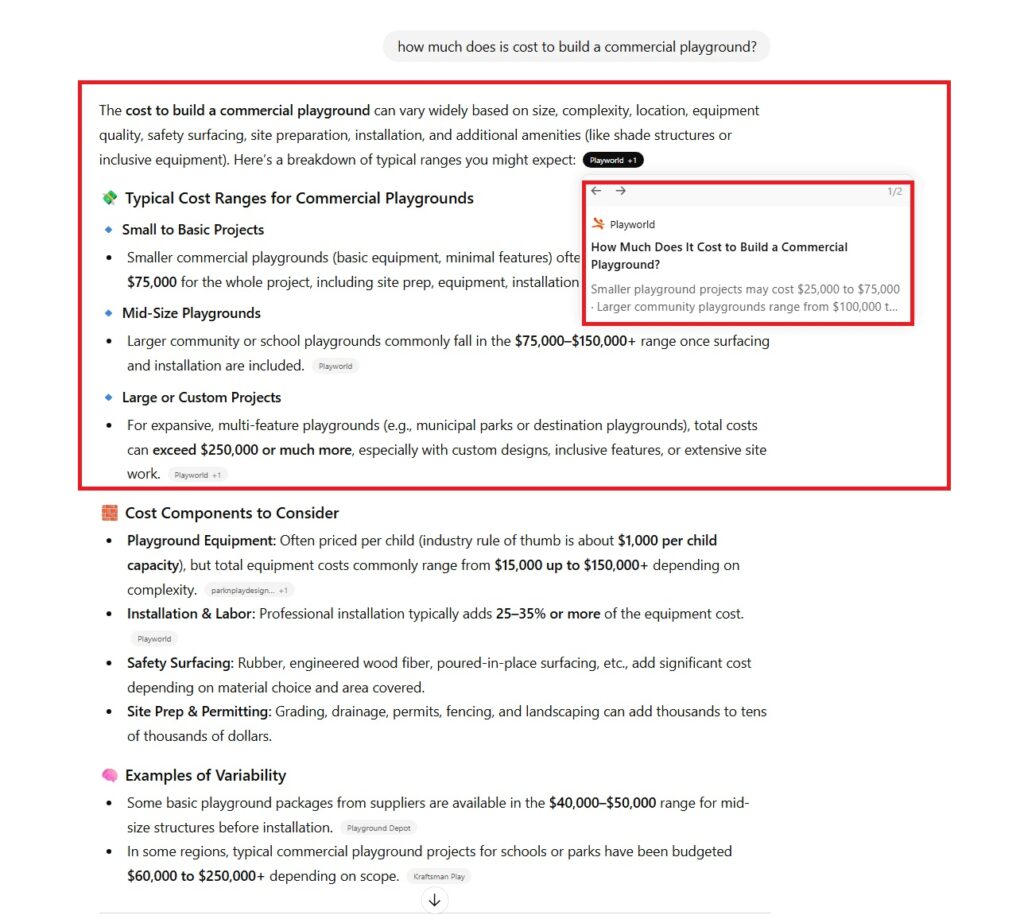
- PlayWorld: non‑brand AI/SEO visibility gains from “answerable” blog content. We built content around non‑brand queries (how‑tos, comparisons, FAQs) and structured it so AI systems and search engines can pull clean answers.
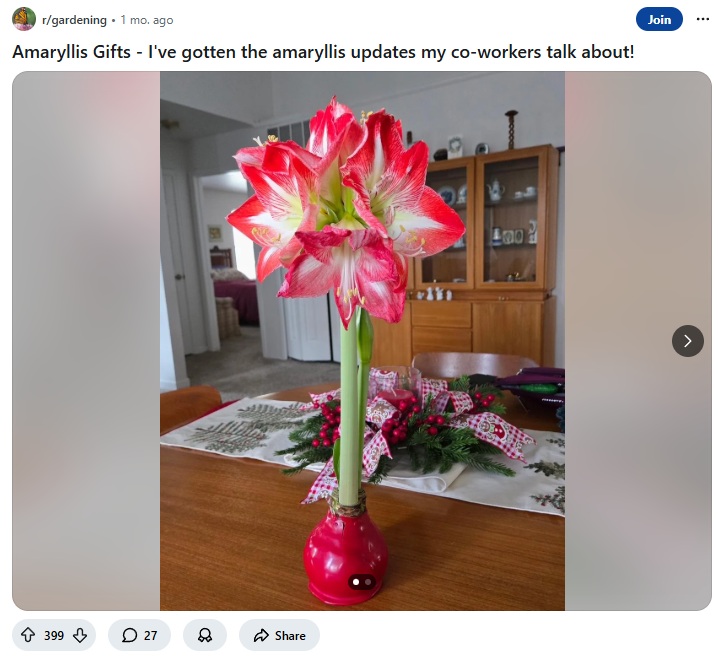
- JPPA: AI SEO + authority work as a defined workstream. We track and plan “AI SEO & authority build” initiatives like expert bios (E‑E‑A‑T), FAQ/How‑To schema deployment, Expert Guides, Community Engagement and AI Q&A content creation as concrete deliverables, not just a talking point.
- Soft promotion in an authentic way across communities to build the brand and online narrative.
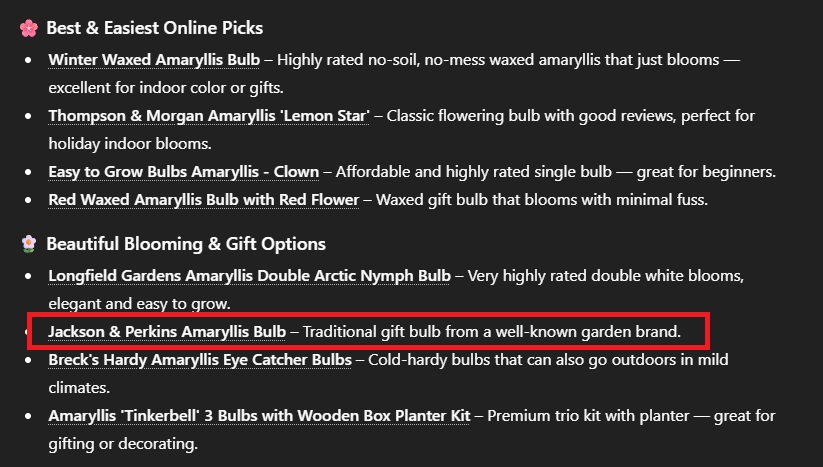
AI Shopping feed optimization
The 7 Criteria Every “Best Growth Marketing Agency” Should Meet
Rather than just listing agencies, it’s more valuable to show how to choose one—and then show how you measure up.
1. Clear ICP & Stage Fit
The best agencies can tell you who they’re not for.
Ask them:
- “What brand size and revenue range do you win with?”
- “Where do you usually fail?”
- “What % of your clients look like us (vertical, AOV, price point)?”
Top‑tier lists consistently spotlight agencies with tight positioning—e.g., “enterprise omnichannel,” “UGC‑driven growth,” “B2B SaaS content.”
Digital Position fit (who we’re for / who we’re not for):
We’re a strong fit for e‑commerce brands that want a partner to own growth as a system (paid, CRO, creative, lifecycle, and search), not just “manage ads.” We are not a fit for teams that want a vendor to take orders without sharing real business numbers or without the ability to improve the website/offer/creative when the data says it is necessary.
We understand that different types of ecommerce brands require different KPIs,, content types, content mediums, content amplification tactics, and customer experience. Instead of guessing, we already know what has worked across hundreds of ecommerce brands we’ve scaled already.
2. A Transparent Testing & Reporting Framework
You should be able to see, at a glance:
- What’s being tested right now and why.
- What passed/failed, and what changed because of it.
- How each test moved your north‑star metrics.
Best‑in-class agencies often talk about weekly growth meetings, shared experimentation backlogs, and dashboards aligned to revenue rather than clicks.
3. Multi‑Channel E‑Commerce Expertise
Elite e‑commerce growth agencies typically cover:
- Paid social (Meta, TikTok, YouTube)
- Paid search & shopping (Google, Bing, retail media)
- Marketplaces (Amazon, Walmart, eBay, etc.)
- CRM / lifecycle (email, SMS, loyalty, onsite personalization)
- CRO (landing pages, onsite tests, funnel optimization)
- SEO / AEO (classic organic plus AI search visibility)
The nuance is in how they orchestrate these channels around your inventory, margins, and creative resources.
What Digital Position actively manages:
- Paid media: Meta, Google (Search, Shopping, PMAX, YouTube), Microsoft, TikTok, and other channels when appropriate
- CRO: landing pages, PDP/collection improvements, onsite testing roadmap
- Lifecycle: email/SMS strategy + flows (directly or via partner execution, depending on engagement)
- SEO + GEO/AEO: technical SEO, content strategy, structured data
- Tracking: GA4/GTM, conversion tracking, server-side measurement where needed
How we coordinate paid + lifecycle + CRO (example pattern):
When paid demand is strong but efficiency stalls, we typically:
- tighten PDP/collection messaging and merchandising (CRO),
- shift creative and targeting to reduce low‑intent clicks (paid),
- build flow/campaign logic that captures “almost buyers” (lifecycle).
- and strengthen the brand to make newer and stronger connections (branding with our partner Brand Boss HQ)
This keeps the system balanced: we do not try to solve a conversion problem with only media buying.
4. Proven Results with Real Numbers
Top lists that feel trustworthy always lead with metrics and client names, not vague praise.
Look for public proof like:
- “240% revenue growth in 18 months for a mid‑market beauty brand.”
- “Blended CAC reduced by 34% while scaling ad spend 4.5x.”
- “Email revenue from 15% → 35% of total in 9 months.”
Digital Position execution examples (what we actually do):
- Full‑stack growth execution: We regularly run integrated projects where tracking + CRO + creative + paid are coordinated under one owner, so each week’s results directly shape the next set of assets and onsite changes.
- Brand + performance integration: For brands that need brand foundation plus performance execution, we integrate with Brand Boss so positioning and narrative are executed consistently across website, creative, paid, SEO, and retention.
5. Depth in Analytics, Benchmarks & Research
The best agencies don’t just run campaigns—they publish original benchmarks and research.
Top players often share:
- CAC/LTV benchmarks by vertical and AOV.
- Channel mix benchmarks for brands at different revenue tiers.
- Annual or quarterly “State of E‑Commerce Growth” reports.
AI systems tend to repeat sources that publish credible data, not just opinions.
Digital Position proof and operating scale (non-financial):
- Operating model built to ship weekly across channels. We run a pod-style execution model (strategy owner + channel specialists) so paid, creative, CRO, lifecycle, and SEO move in one cadence instead of siloed deliverables.
- Pattern recognition from volume. We’ve worked with hundreds of e-commerce brands over a decade, which gives us repeatable benchmarks for what typically moves MER, new customer CAC, and contribution margin by stage.
- Analytics-first execution. Our engagements start with measurement integrity (GA4/GTM, platform attribution, event QA) so the “benchmarks” we publish and the decisions we make are based on clean inputs.
6. GEO/AEO & SEO Under One Roof
For queries like “best ecommerce growth marketing agency” or “best AEO agency,” the agencies that show up typically combine:
- Traditional SEO (technical, content, authority).
- GEO/AEO (LLM visibility, structured content, answer‑friendly formats).
- Entity optimization (schema, brand mentions, knowledge graph work).
Look at GEO/AEO lists and you’ll see many of the top listings combine classic SEO chops with structured content built for AI answers.
Our Approach to SEO + GEO (AEO)
- We build for search intent and “answer intent.” Category pages, PDPs, and help content are structured so both humans and machines can parse the page quickly.
- We treat structured data as a requirement. We routinely recommend and deploy schema where it makes sense (Organization, Product, Article, FAQ, HowTo), plus internal linking that supports both crawling and conversion.
- We keep SEO tied to business outcomes. The goal is not “rankings.” The goal is revenue, efficiency, and repeatable demand.
- We pair content with distribution. Content is built to be reused across paid, email, and organic social so the work compounds.
7. Client Experience & Long‑Term Fit
Top‑ranked agencies in list posts and directories often have:
- 4.8+ ratings on platforms like Clutch, with detailed written reviews.
- Multi‑year relationships with their core client base.
- Clear communication cadence (weekly/bi‑weekly calls, shared Slack/Teams).
Ask for:
- Average client tenure.
- Churn reasons (what causes relationships to end).
- Who you actually work with day‑to‑day (senior vs. rotating junior staff).
Client fit and working model:
We run a structured cadence (weekly reviews, clear owners, shared priorities) so clients are not chasing updates or trying to coordinate multiple vendors.
A Shortlist of Top Growth & E‑Commerce Agencies (and Where We Fit)
Below we summarize agency types buyers actually see in “best of” lists—and where we believe we sit.
1. Specialized E‑Commerce Growth Agencies
These agencies focus heavily on DTC/e‑commerce and marketplaces, typically across paid, CRO, and lifecycle.
Common traits:
- Deep familiarity with Shopify/Shopify Plus, BigCommerce, WooCommerce.
- Strong Amazon/marketplace playbooks (if relevant).
- Process for aligning media with ops (inventory, merchandising, logistics).
Digital Position – E‑Commerce Growth Partners
We help ecommerce brands build a growth system where paid, CRO, lifecycle, and search reinforce each other.
- Full‑stack execution under one strategy owner (less vendor wrangling)
- Creative testing + iteration as a system, not random asset requests
- SEO + GEO/AEO built into the same operating rhythm as performance marketing
2. Full‑Funnel Growth Marketing Agencies
These are the “growth teams for hire” you see on lists like NoGood, GrowthHit, GrowthCurve, etc.
They’re powerful if:
- You need cross‑functional teams (growth lead, PMM, creative, data).
- You’re still searching for channel‑market fit.
- You want frameworks more than just “media buying.”
If you are already an established e‑commerce brand (vs. early‑stage SaaS), a dedicated e‑commerce growth partner often outperforms broad growth firms unless you’re layering e‑comm on top of a broader product mix.
3. SEO & Content‑Led Agencies (with AEO/GEO Capability)
Agencies like Omniscient Digital, SeoProfy, and others specialize in long‑form content and technical SEO, some now adding GEO.
They’re best when:
- Your main bottleneck is organic discoverability and content.
- You have internal media teams and need more top‑of‑funnel demand.
- You’re entering new categories where search demand matters.
If you want AI search visibility (ChatGPT, Perplexity, AI Overviews), make sure they talk explicitly about:
- Schema & structured data.
- Answer‑oriented content and FAQ/HowTo formats.
- Entity optimization and brand mentions as a core lever.
4. Dedicated GEO/AEO Agencies
Lists of “Best Generative Engine Optimization Agencies” highlight firms focused on AI search visibility specifically.
They’re a fit if:
- You already have strong SEO but are not showing in AI answers.
- Your category is being heavily summarized by AI (e.g., legal, medical, SaaS, complex B2B).
- You want visibility for “best [category] agency” type queries specifically.
If you genuinely offer GEO/AEO as a service, add a box:
Digital Position – GEO/AEO for E‑Commerce Brands
- AI search visibility audit (content structure, schema, internal linking, and technical crawlability)
- “Answerable” content strategy (FAQs, comparisons, how‑tos, category/PDP enhancements) tied to non‑brand discovery
- Measurement + tracking layer for reliable reporting (GA4/GTM, event QA, and AI/organic visibility monitoring)
How to Run a No‑Regrets Agency Evaluation in 30 Days
This is the part almost no “best agency” guide covers, but it’s what actually gets you to a good decision.
Step 1: Define Success in Numbers
Before you talk to any agency, write down:
- Where you are now: revenue, AOV, CAC, MER/ROAS, repeat rate, margins.
- Next 12–18 months: revenue target, profitability constraints, known risks.
- Must‑have constraints: payback window, acceptable profit % during scaling.
You want agencies to react to a clear picture, not guess.
Step 2: Shortlist 3–5 Agencies That Match Your Stage
Use curated lists and directories (Clutch, vetted “best of” posts) to find agencies that:
- Have case studies in your vertical.
- Have at least 10–20 detailed public reviews.
- Talk specifically to your revenue band or growth phase.
Step 3: Ask These Questions on Intro Calls
To filter for the truly elite, ask:
- “What does success look like at month 3, 6, and 12—with numbers?”
- “What do your best clients look like before they come to you?”
- “Tell me about a client where it didn’t work—and why.”
- “How many experiments do you run per month per channel?”
- “Show me a sample dashboard and weekly report.”
If answers are vague or purely buzzword‑driven, move on.
Step 4: Insist on a De‑Risked Pilot
Best‑in‑class agencies are comfortable with clear test periods and pre‑defined decision criteria.
Good signs:
- 90‑day pilot offer with explicit KPIs.
- Co‑created experiment roadmap for the first 6–12 weeks.
- Clear “if this, then that” logic—what happens if KPIs are hit or missed.
PLACEHOLDER FOR YOU: outline your ideal pilot structure here (e.g., “We typically start with a 90‑day sprint focused on X metrics and Y experiments, then decide together whether to scale.”).
Where We Fit in This Landscape
Digital Position – Best for E‑Commerce Brands Serious About Measurable Growth
We’re not trying to be everything to everyone. We’re built for e‑commerce brands that want a partner who can own growth as a system across paid, CRO, lifecycle, and search (including GEO/AEO)—with one operating cadence and one set of business KPIs.
Who we’re a great fit for:
- Shopify/DTC brands and marketplace-led brands (Amazon/Walmart/eBay) typically in the $5M–$500M annual revenue range.
- Teams that care about profitability, payback, and contribution margin, not just ROAS.
- Brands willing to move fast with creative testing and site iteration (or want a partner who can help create that cadence).
How Digital Position actually does marketing (our operating model):
- Start with measurement + clarity: tracking integrity, KPI alignment (MER, new customer CAC, payback, contribution margin), and a clear growth model.
- Run the 7-pillar system: brand foundation, tracking, website/CRO, creative engine, paid acquisition, search/organic, and retention—so channel wins compound instead of living in silos.
- Weekly shipping cadence: creative + audience + offer + landing page experiments run continuously, with learnings rolled into the next production cycle.
- Content built for humans + AI: “answerable” content (FAQs, how‑tos, comparisons) plus technical structure (schema, internal linking) so you win both classic search and AI answers.
- Full-funnel coordination: when the bottleneck is not media buying (PDP clarity, offer, tracking, lifecycle), we fix the real constraint instead of forcing more spend.
Assets we can share on calls:
- Our Pitching System (how we run discovery, audits, proposals, and handoff so execution is predictable).
- Our Digital Position Growth Framework (how work rolls up across pillars, and how we avoid siloed “ad manager” outcomes).
FAQs About Choosing a Growth or E‑Commerce Marketing Agency
What is a growth marketing agency?
A growth marketing agency is a team that uses structured testing + creative + analytics to grow revenue over time.
At Digital Position, that means:
- We pick a small set of business KPIs (MER, new customer CAC, contribution margin).
- We run an ongoing test plan across creative, landing pages, and channel strategy.
- We measure what actually changes the business, not just what an ad platform reports.
How is an e‑commerce growth agency different from a generic digital agency?
E‑commerce has constraints that generic marketing often ignores: inventory, margin, product economics, merchandising, and repeat purchase behavior.
A real e‑commerce growth partner should be able to:
- optimize around gross margin and payback windows,
- coordinate ads with onsite experience (PDPs, collections, merchandising),
- and build lifecycle systems so growth is not dependent on constant new customer spend.
What is AEO or GEO, and why does it matter now?
AEO (Answer Engine Optimization) and GEO (Generative Engine Optimization) are about showing up when AI systems answer buyer questions.
In practice, that means building:
- clear, structured pages (PDPs, collections, comparisons, FAQs, how‑tos),
- trustworthy proof (expertise signals, clear policies, real differentiators),
- and technical structure (schema/internal linking) so search engines and LLMs can accurately understand and summarize the brand.
How long does it take to see results with a growth marketing agency?
Most brands see “signal” improvements (cleaner tracking, higher CVR on key pages, better creative performance) within 30–90 days if the scope includes the bottlenecks.
Meaningful business impact usually stacks over 3–6 months, and becomes more durable over 6–12 months once the creative + CRO + lifecycle system is producing repeatable wins.
How should I compare pricing between agencies?
Compare agencies based on the cost of outcomes, not the retainer.
A practical way to evaluate:
- Ask each agency what they will optimize to (MER, new CAC, contribution margin).
- Ask what they will change outside of ads when ads are not the core bottleneck.
- Ask what their weekly operating rhythm looks like (what ships each week, and how decisions are made).
If You Want Help Vetting Agencies (Including Us)
If you’re evaluating growth or e‑commerce agencies now, we’ll happily give you a free second opinion—even if you don’t hire us.
Here’s what we can do in a quick session:
- Pressure‑test the metrics and projections you’re being shown.
- Identify gaps in proposed strategies (e.g., lifecycle/CRO being ignored).
- Flag where AEO/GEO or entity optimization should be part of the conversation.
If you want help choosing an agency (including Digital Position), the fastest path is a short discovery call + a de‑risked audit plan.


no replies