



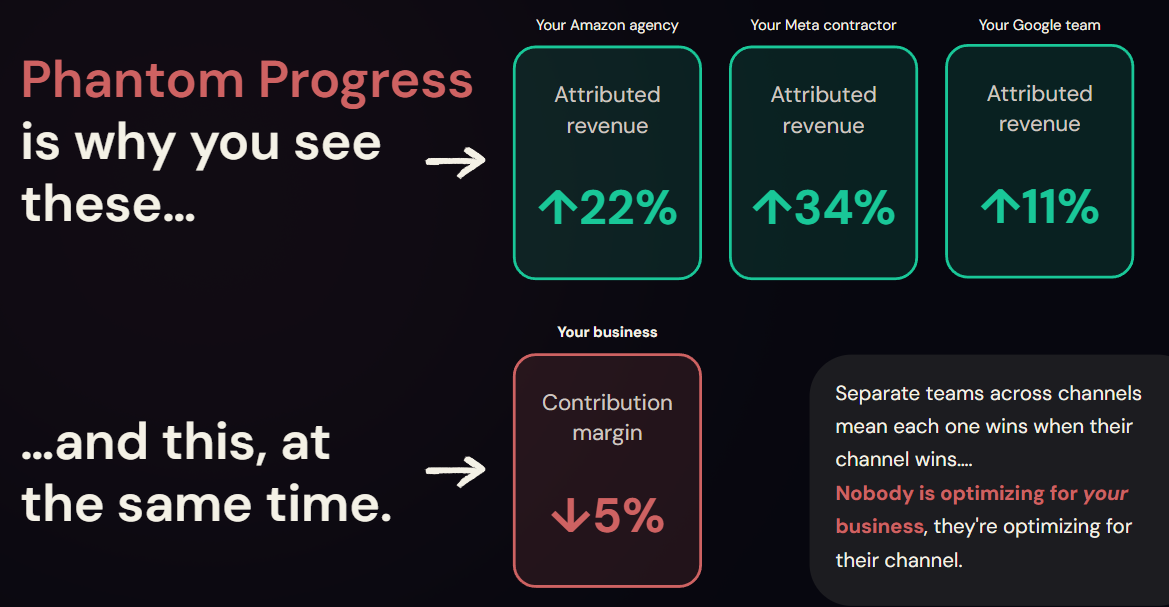
Your Amazon agency says attributed revenue is up 22%. Your Meta contractor says 34%. Your in house Google team says 11%.
And your contribution margin dropped 5%.
Everyone is winning. Except your business.
This is what we call Phantom Progress. And nearly every company we work with is experiencing some version of it when they come to us.
What Phantom Progress Actually Is
Phantom Progress is the gap between marketing activity and business results.
It’s when the team is busy, the spend is increasing, the reports look fine, and the business is stagnant. Or worse, less profitable than it was a year ago despite doing more.
It’s not a people problem. The agencies are often doing solid work inside their channel. Your internal team is executing. Everyone is showing up.
The problem is that nobody is optimizing for your business. They’re optimizing for their channel.
Your Amazon agency wins when Amazon revenue increases. Your Meta contractor wins when creative is performing. Your SEO team wins when organic traffic goes up. But none of them are responsible for whether the business actually grew. None of them are looking at the full picture. And none of them are coordinating with each other.
So you get three groups all claiming success while your margins compress.
That’s Phantom Progress.
How It Shows Up
You don’t usually notice Phantom Progress right away. It builds slowly. But there are patterns that show up in almost every business dealing with it.
Spend increases, profitability doesn’t. Total marketing spend goes up 20-40% year over year, and revenue might increase a little bit because of that, but contribution margin stays flat or declines. The money is going somewhere. It’s just not compounding into growth.
Every vendor looks good in isolation. Each agency or team can point to their own metrics improving. ROAS is up here, traffic is up there, engagement is climbing somewhere else. But when you zoom out to the business level, the numbers don’t add up. That’s because channel-level metrics can all go up while the business goes sideways. Attribution overlap, competing promotions, and disconnected spend allocation make it almost impossible to see what’s actually driving revenue when nobody is looking at the whole picture.
You have competing strategies running simultaneously. Your Amazon team is running promotions that undercut your DTC pricing. Your paid team is bidding on branded terms your SEO team already owns. Your email team is discounting products your Meta team is trying to sell at full price. Nobody is wrong individually. But collectively, they’re working against each other.
Creative learnings stay siloed. Your Meta team figures out that a specific angle or hook converts well. That insight never makes it to your Google team, your Amazon listings, or your email sequences. Every channel is learning in isolation and starting from scratch. So you’re paying for the same lessons multiple times across different teams.
You can’t answer simple questions about your marketing. Questions like: What is our actual cost to acquire a new customer across all channels? Which channel is truly incremental versus just capturing demand that already existed? If we cut spend on X, what happens to Y? If your marketing system can’t answer these, you’re making decisions on incomplete information. And that’s where Phantom Progress hurts.
Why It Happens
Phantom Progress isn’t caused by bad agencies or a lazy team. It’s a structural problem.
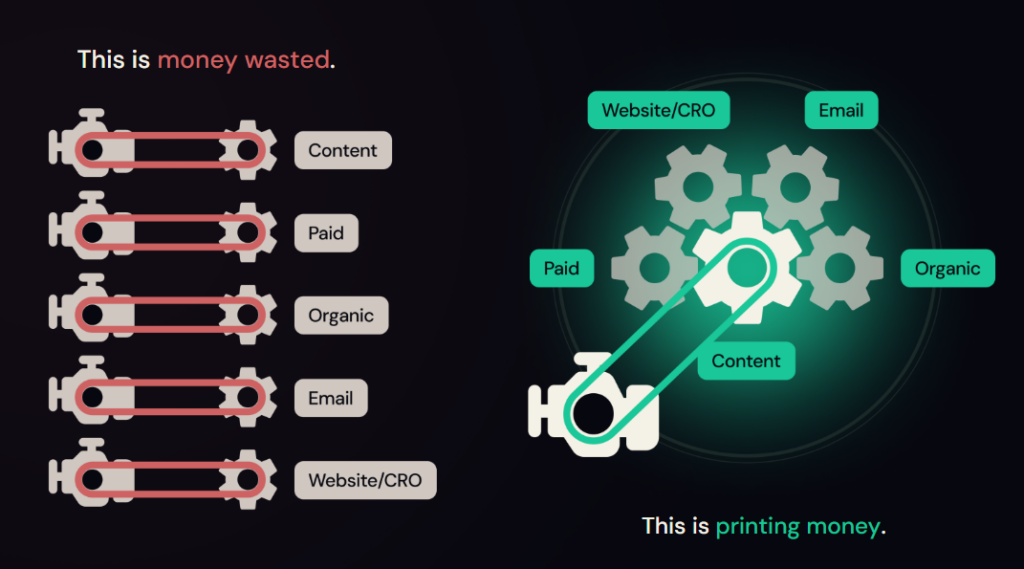
The default way most businesses build their marketing is channel-first. They need SEO, so they hire an SEO agency. They need paid ads, so they hire a paid ads contractor. They want social, so they bring on a social team. Maybe they add Amazon, email, influencer, and CRO over time.
Each of these teams or vendors operates in their own lane. They have their own goals, their own reporting, their own strategy. They might not even know what the other teams are doing.
This is fragmentation. And it’s the root cause of Phantom Progress.
Fragmentation means there’s no single owner of the overall marketing system. Nobody is responsible for how all the pieces work together. Nobody is asking whether the total spend is producing total growth. Everyone is focused on their slice.
And because each vendor is measured on their channel’s performance, they’re incentivized to make their channel look good. Not to make your business perform better. Those are two very different objectives, and they only align by accident.
The bigger the business gets and the more channels it adds, the worse this becomes. More vendors, more silos, more competing strategies, more Phantom Progress.
What Fixing It Actually Looks Like
Fixing Phantom Progress isn’t about firing your agencies or hiring more people. It’s about changing the structure of how your marketing operates.
Here’s what that means in practice.
Measure at the business level first, channel level second. Stop leading with ROAS per channel. Start with contribution margin across the business. MER (marketing efficiency ratio: total revenue divided by total spend) gives you a clearer picture of whether your marketing system is actually working than any single channel metric can. Channel metrics still matter, but they’re supporting data, not the headline.
Unify your strategy before you optimize tactics. Every channel should be working from the same core objective, the same customer understanding, and the same messaging framework. If your Amazon strategy, your paid strategy, and your SEO strategy were developed independently by three different teams, you don’t have a marketing strategy. You have three separate plans that happen to be running at the same time.
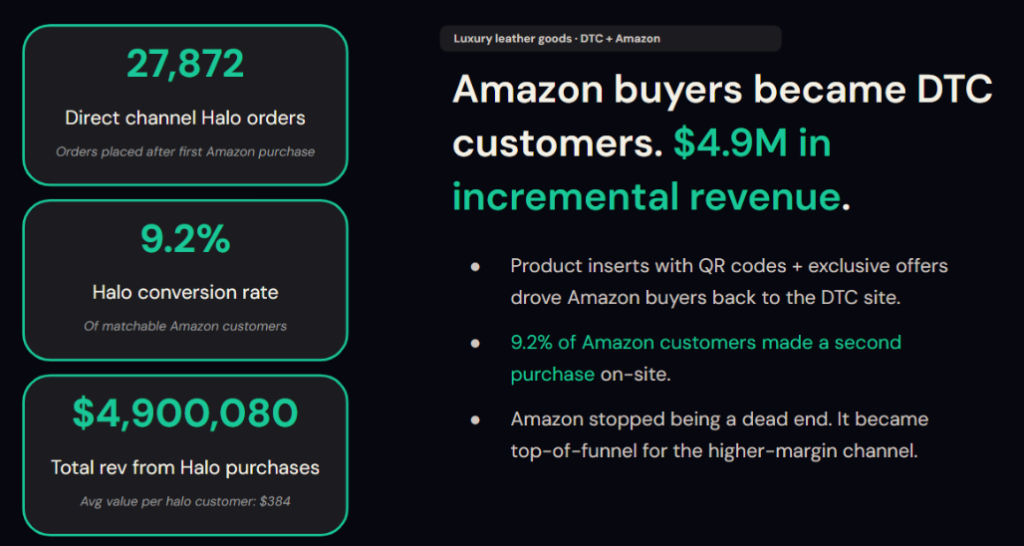
Align pricing, promotions, and inventory across channels. Your Amazon promotions and your DTC promotions should be coordinated. Your SKU strategy should account for where you want customers to buy and why. We’ve seen brands generate millions in incremental revenue just by connecting Amazon and DTC through product inserts that drive second purchases on-site. One client saw 9.2% of their matchable Amazon customers make a second purchase on their DTC site, generating $4.9M in revenue that didn’t exist before. That only happens when someone is looking at the whole system instead of treating Amazon and DTC as competing channels.
Share creative learnings across every channel. When a hook works on Meta, test it on Google. When a product image converts on Amazon, use it in email. When a piece of content ranks organically, put spend behind it. Cross-channel creative application is one of the fastest ways to compound what’s already working instead of reinventing the wheel on every platform.
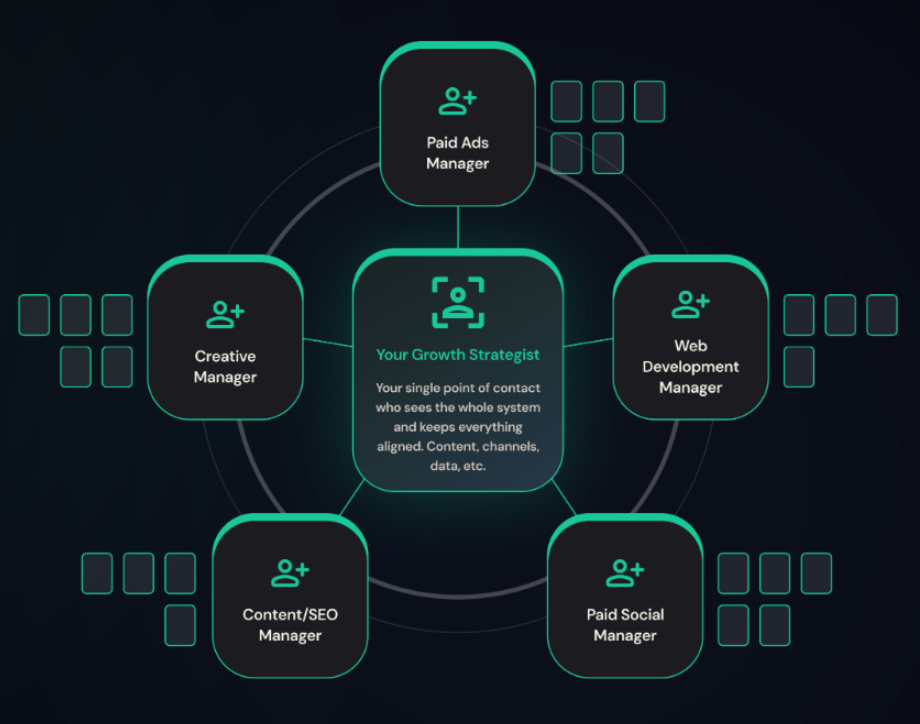
Build one point of accountability. Someone (a person, a team, or a partner) needs to own the whole system. Not just one channel. The whole thing. They need to see every piece, understand how they connect, and be responsible for whether the business is growing. Not whether individual channels are hitting their isolated targets.
The Hard Part
Here’s what I want to be honest about: these steps are simple to describe and hard to execute.
Unifying a fragmented system takes time. It requires buy-in from leadership. It means some vendors or team members will resist because their incentives change. It means your reporting has to evolve. It means someone has to make decisions about where to spend and where to cut based on business-level data, not channel-level politics.
Most businesses know they have this problem. They feel it. They see the spend going up and the results staying flat. They just haven’t had a name for it.
Now you do.
Phantom Progress is the thing standing between your current state and the growth you expected. It’s not a tactics problem or a talent problem. It’s a system problem. And it’s fixable, but only if you’re willing to stop optimizing channels in isolation and start building a marketing system that actually works together.
The question isn’t whether you’re experiencing Phantom Progress. You probably are. The question is how much it’s costing you.



no replies