



Whitelisted Vs. UGC

Why aren’t your UGC ads performing like they used to?
It’s not just you. UGC performance is falling across all industries. CPM (Cost per 1000 impressions) is rising on Meta, and CPC (Cost Per Click) is climbing right along with it.
The reason is that customers are tired of looking at ads, and posting UGC content from your brand account isn’t fooling anyone anymore.
That’s the big difference between a Whitelisted ad and a UGC ad.
UGC is immediately recognizable as an ad because it’s coming from a brand’s account. Whitelisting, on the other hand, means posting your content on the creator’s account. It’s a small technical change, but a huge psychological one.
And it can lead to a huge difference in performance, too.
What’s the Difference Between UGC and Whitelisting?
Most marketers lump the two together, but they’re not the same.
UGC ads use creator-made content, but they’re run by your brand account, so it’s still a brand doing the talking. To the audience, it’s just an ad wearing a hoodie instead of a suit.
Whitelisting uses the same content, but the ad is published from the creator’s own handle. Even though there’s ad spend behind it, the viewer sees the post coming from an account they already follow and already trust.
It looks and feels like an organic post, instead of a sponsored one.
Why Whitelisting Works Better
1. Trust is built in.
People trust people, not pages. The moment the content comes from a creator, it carries social proof and credibility that your brand’s handle can’t match.
2. Lower CPMs.
Meta’s algorithm treats whitelisted posts more like organic, which means you pay less per impression.
3. Higher intent clicks.
Whitelisted ads tend to have fewer total clicks, but the ones you get are from users who actually care. CTR (click-through rate) may drop, but CVR (conversion rate) rises, and takes ROAS (return on ad spend) along for the ride.
4. Longer watch times.
Because the post doesn’t “feel” like an ad, users stay longer and engage deeper. That higher hold rate compounds performance over time.
And it’s not just a bout improving metrics either. Whitelisting changes the kind of results you’re getting. It acts as an upper-funnel engine that builds awareness and future demand, compared to your traditional UGC content, which focuses on conversions.
How Whitelisting Works for a DTC Brand
Brickhouse Nutrition is a leading supplement manufacturer, and its team prides itself on being science-backed.
So when we saw UGC performance falling and proposed a pivot to whitelisted ads, they said, “Let’s see some test results.”
We tested the video ads two ways:
As a brand-run UGC post,

and whitelisted through the creator’s handle.

Here’s what happened:

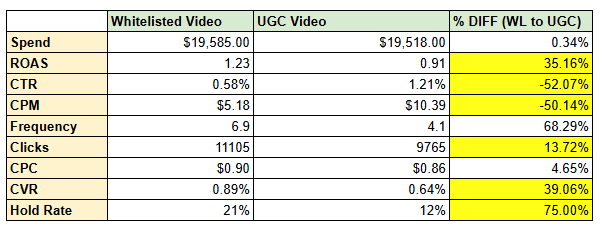
CPM dropped by 79% – From $12.43 when run on the brand account to $2.52 when we put the spend behind the creator’s account.
The hold rate (view time) increased by 75%, and CVR increased by 39.06%.
The CTR dropped by 44% and that might look like a red flag to some. But it means we’re filtering out low-intent traffic and spending only on viewers who are genuinely interested, even if they’re only at the beginning of their buying journey..
ROAS increased by 35.16%.
At first glance, the brand-run UGC version looks more efficient. It had a slightly lower CPA (cost per acquisition) and a higher AOV (average order value).
But the whitelisted ad created a much broader upper-funnel impact.
The whitelisted version featured an aesthetic, lifestyle-oriented voiceover talking about mobility, Pilates, and caring for your body after 30. The creator hardly mentioned the product. It was a natural extension of her story.
So Meta treated it as highly organic. We got over 1 million impressions at an extremely low CPM.
At the same time, the UGC ad from the Brickhouse account was more direct:
Traditional product-forward creative, purely focused on conversion.
It looked and sounded like an ad. That helped it convert existing shoppers who were already looking for collagen supplements, but did very little to expand that audience.
Both types of content are valuable, just for different jobs.
- Whitelisted ads create demand and build audience awareness.
- Brand-led UGC ads capture demand and drive immediate conversions.
Smaller brands can survive on conversion-focused UGC alone.But as spend scales, the ability to build the next wave of customers becomes essential.
That’s where whitelisting shines.
The Takeaway: Whitelisting Gives You Scalable Authenticity
The formula is simple:
Creator credibility × paid reach = efficient growth.
You still get the relatability of creator content, but now you deliver it through a channel audiences already believe in. They trust the messenger, so they don’t see it as an ad and immediately scroll away.
That’s how you scale authenticity without sacrificing performance.
If your UGC ads are starting to plateau, whitelisting is the next logical step.
Key Takeaways
- Stop running every UGC ad ONLY from your brand page.
- Use whitelisting to borrow trust from creators your customers already follow.
- Expect lower CPMs, longer engagement, and higher conversion rates.
- Don’t chase CTR. You want to chase QUALIFIED clicks.
- Authenticity is the new optimization metric.
Whitelisted ads spark awareness and shape perception, while UGC ads capture intent and close sales.
Together, they give brands scalable authenticity and a balanced funnel.
Frequently Asked Questions
What is whitelisting in advertising?
It’s when a brand runs paid ads through a creator’s social account instead of its own, using the creator’s name and profile to publish the content.
Is whitelisting the same as UGC?
No. UGC is creator content run under your brand handle. Whitelisting is running that content under the creator’s handle.
Why does whitelisting outperform UGC?
Because it feels native. The algorithm sees it as organic, and the audience sees it as real.
Does whitelisting lower CTR and hurt results?
Yes, but no. Every click costs less and converts better. It’s efficiency, not volume, that drives higher ROAS.
How do I start using whitelisting?
Partner with creators who already fit your audience, negotiate ad access through Meta’s partnership tools, and test UGC style ads posted through their accounts.
When does whitelisting work best?
During high-traffic seasons or when scaling proven creator content. Whitelisting combines trust with paid reach.
Should I stop running UGC if whitelisting performs better?
No. Think of them as two parts of one system. Whitelisted ads build top-of-funnel awareness, and UGC ads convert those warmed audiences. The right mix depends on your budget and stage of growth.






no replies