



TL;DR
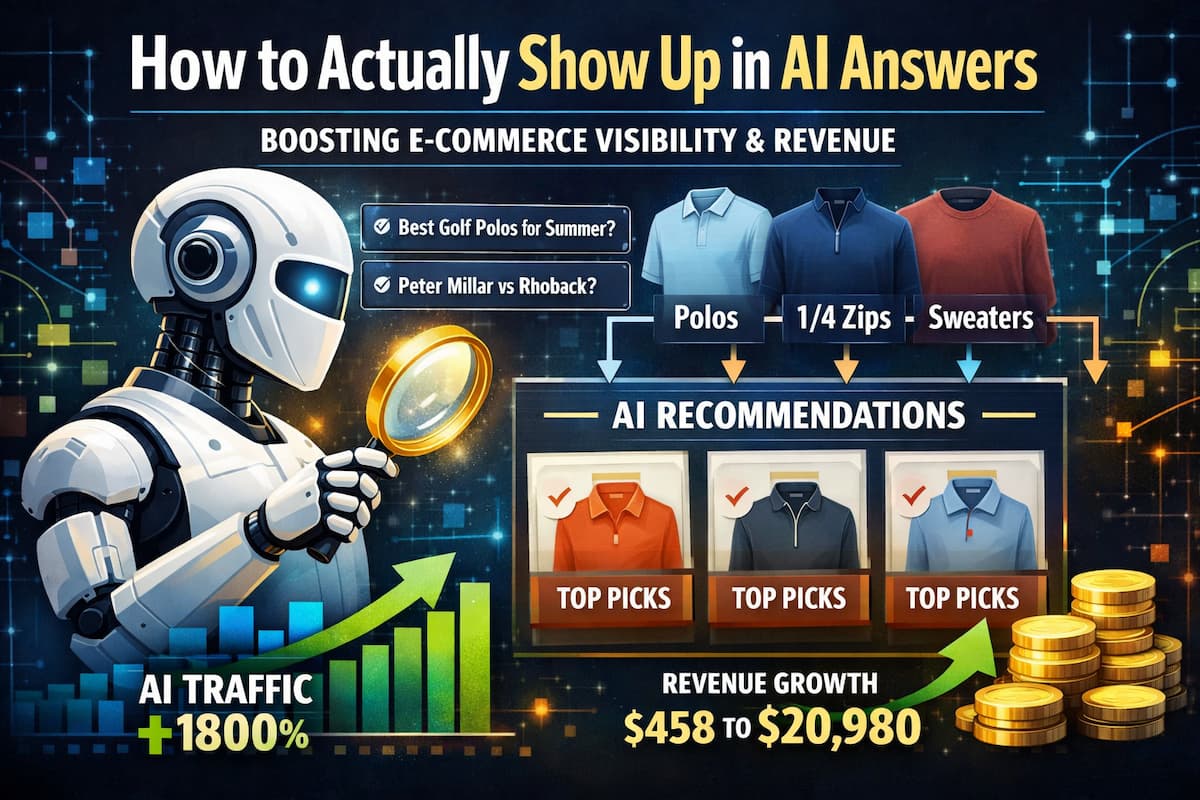
- Peter Millar had strong brand recognition but limited AI recommendation visibility
- Replace broad categories like “Tops” with specific product groupings like Polos, Quarter-Zips, and Sweaters so AI can clearly classify what you sell
- Align category architecture with “best [product] for” and “[brand] vs [brand]” queries to target customers closer to purchase
- Implement structured data across category and product pages so AI systems can extract and trust your product structure
- Fix crawlability and indexation issues to ensure AI platforms can access key category and product pages
- When structure, intent, and technical clarity align, AI inclusion increases (AI sessions grew from 104 to 1,980 and revenue rose from $458 to $20,980 in 12 months)
This case study outlines the exact structural and technical changes required to rank in AI product recommendations.
How to Actually Show Up in AI Answers
Peter Millar had strong brand recognition and healthy traditional SEO performance. But AI product recommendations rarely included them. They already had the authority they needed. We just had to add precision.
The goal was to rank in AI product recommendations when customers were actively evaluating options.
AI systems like ChatGPT and Gemini prioritize clarity and classification. They surface brands that are easy to map to specific product types and buying scenarios.
When a user asks, “What’s the best golf polo for hot weather?” the model looks for structured product groupings tied to that use case. It pulls from brands whose categories, metadata, and schema reinforce exactly what they sell.
Our focus was making that authority machine-readable and aligned with purchase intent.
Why Category Structure Changed AI Visibility
Most e-commerce sites are organized for merchandising. That works for navigation, but AI systems rely on specificity.
Categories like “Tops” group products in a way that works for shoppers. But when someone asks, “What’s the best golf polo for summer?” the AI isn’t going to think the best result is a brand that sells “tops.” It looks for brands clearly associated with golf polos.
We reorganized navigation around defined product types:
- Polos
- 1/4 Zips
- Sweaters
- Button-Ups
- Pants
- Shorts
That structure matches how customers search and how AI evaluates product categories.
This change alone strengthened classification signals across the site and increased eligibility for product-focused answers.
Why Buying-Intent Search Terms Are More Important For AI
Yes, users are still searching with informational queries like “What is performance fabric?” But optimizing for those searches won’t drive traffic from AI like it used to on Google.
That’s because AI answers most definitional questions directly without a reference or link.
Buying-intent prompts work differently. These are the prompts that determine whether a brand ranks in AI answers.
Searches like “best golf polos for humid weather” or “Peter Millar vs Rhoback” signal evaluation. These are questions from someone who’s choosing between options. Someone close to making a purchase that AI models want to facilitate.
Buying-intent prompts are where AI shifts from answering questions to making recommendations. This is the moment the model behaves less like a search engine and more like a salesperson.
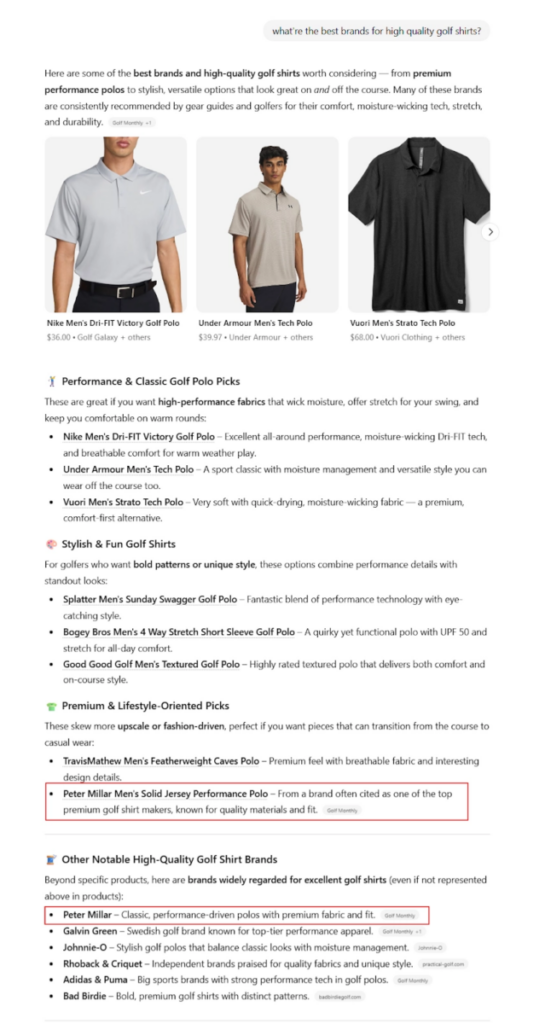
That behavior is already happening, and it will only increase as AI platforms move closer to monetizing purchase decisions.
AI SEO vs Traditional SEO
Traditional SEO optimizes for rankings in a list of results.
AI SEO optimizes for inclusion inside a recommendation set.
Google ranks a list of options. AI selects and recommends brands and products.
The Technical Changes that Drive AI Traffic
AI traffic grew because of tighter alignment between structure, intent, and machine readability.
The most impactful work included:
- Reorganizing category architecture around defined product types
- Mapping high-intent search modifiers to category and supporting content
- Implementing Product and ItemList schema across category and PDP templates
- Resolving crawlability and indexing gaps that limited machine access
- Improving metadata to match product-level specificity
Each change strengthened how AI models classify products, extract information, and determine which brands to recommend.
Why Showing Up in AI Drives Revenue
AI visibility happens at the moment of evaluation.
When someone searches “best golf polos for humid weather,” they are not researching fabric definitions. They’re deciding between brands.
As Peter Millar appeared more consistently in product-focused AI responses, qualified sessions increased.
Over a 12-month period:
- AI sessions increased from 104 to 1,980
- Purchases grew from 2 to 50
- Revenue increased from $458 to $20,980
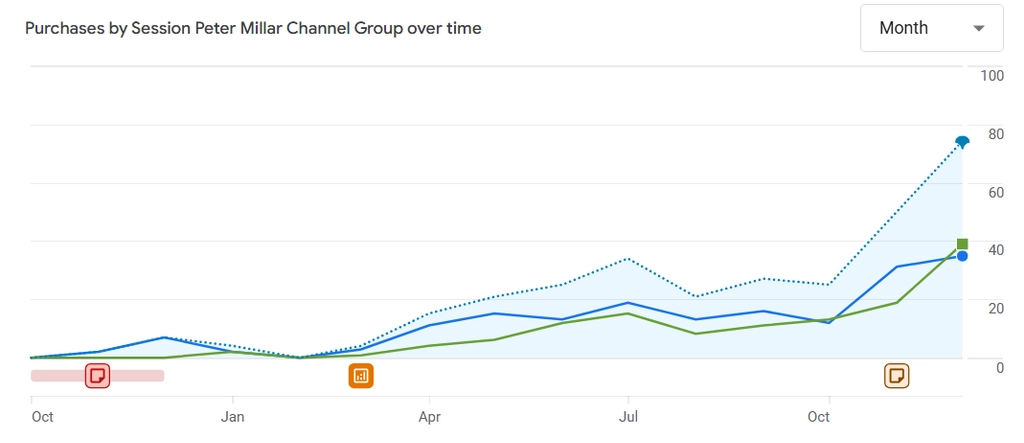
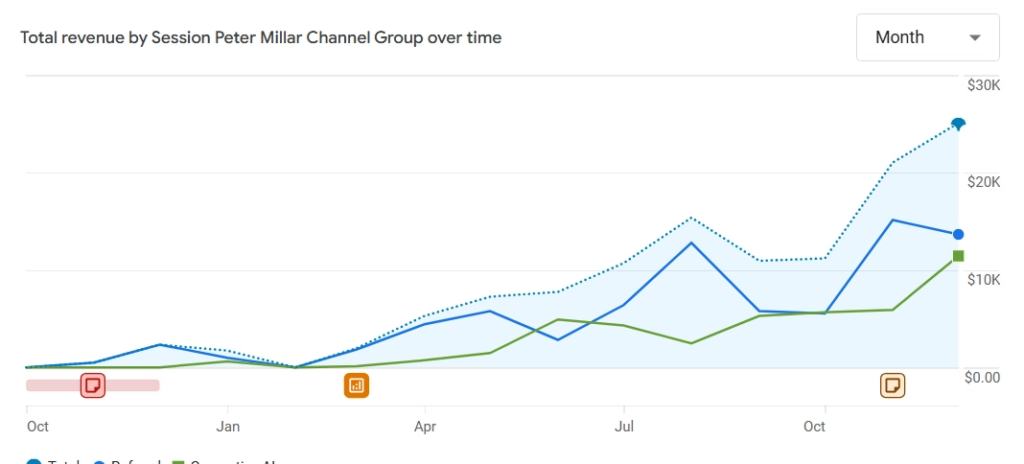
Engagement metrics followed the same pattern. Session key event rate improved, event count scaled significantly, and total revenue per session increased.

Showing up in AI increases exposure when buying intent is highest. In AI-driven commerce, visibility and recommendation are directly connected.
When a brand is included in the recommendation set, it captures demand at the point of selection. That alignment is what translated inclusion into revenue growth.
What This Means for E-commerce Brands
AI visibility is not driven by volume as much as it’s driven by clarity.
Brands that show up consistently in AI recommendations make it easy for models to understand what they sell, who it’s for, and when it should be recommended.
That requires:
- Specific category architecture
- Alignment with buying-intent queries
- Structured data that reinforces product types
- Clean crawlability and indexation
Peter Millar already had authority. Once structure, intent, and machine readability aligned, inclusion increased.
As inclusion increased, qualified traffic followed. And when qualified traffic increases at the moment of evaluation, revenue grows.
AI is becoming a recommendation layer across search. Brands that are structurally aligned with that layer will capture more demand as it expands.
Brands that want to rank in AI answers must optimize for structure, intent, and extractability, not just content volume.
Frequently Asked Questions
How do you rank in AI product recommendations?
Align category structure with specific product types, target buying-intent queries like “best [product] for,” and implement Product schema so AI can clearly extract and classify what you sell.
How is AI SEO different from traditional SEO?
Traditional SEO optimizes for rankings in search results. AI SEO optimizes for inclusion inside AI-generated recommendations
What search terms help brands rank in AI answers?
Buying-intent terms like “best [product] for” and “[brand] vs [brand]” have the strongest impact because they signal evaluation and selection.
Do informational blog posts still matter for AI?
Yes, but mainly for brand association. Buying-intent alignment determines whether your brand gets recommended.
Why does category structure affect AI rankings?
AI models rely on clear product classification. Specific categories strengthen signals. Broad retail buckets dilute them.
What technical changes improve AI traffic?
Product and ItemList schema, clean crawlability, proper indexation, and metadata aligned with product specificity.
Does AI traffic convert better?
Often yes. AI recommendations appear during evaluation, when purchase intent is highest.



)
no replies