



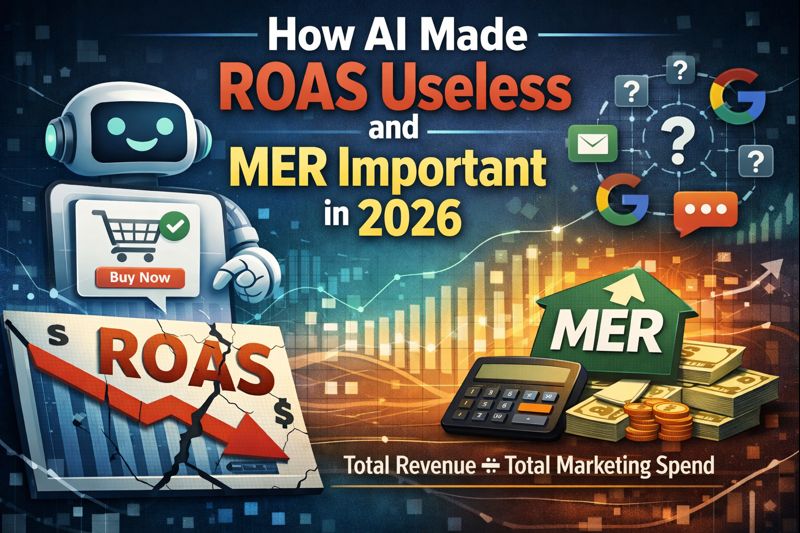
ChatGPT giving users the ability to research and buy products without ever leaving the chat created a new, powerful sales channel for many Shopify stores. It also broke ROAS-focused strategy.
ROAS was every marketer’s favorite metric, but it’s been a shaky way to run an e-commerce business for a few years now. ChatGPT’s in-chat purchases just made the problem impossible to ignore.
When discovery, recommendation, and checkout all happen inside one AI interface, there’s no clean “this sale came from Meta” or “this one was Google.” Fees stack, attribution data sucks, and any brand still optimizing channel by channel is going to make bad decisions fast.
Forget ROAS, Make the Move to MER Now
ROAS assumes you can clearly tie revenue back to a single platform.
That was barely true before. It’s definitely not true now.
When a customer researches in ChatGPT, gets a recommendation there, maybe saw a Meta ad last week, clicked a Google Shopping ad two days ago, and then checks out inside an AI interface, platform ROAS doesn’t tell you the real story.
ROAS no longer shows what’s working and what’s wasting your budget. But worse…
ROAS tells you nothing useful about whether the business is actually healthy.
Tracking your Marketing Efficiency Ratio (MER) fixes that.
MER is a top-level profitability metric that looks at how much revenue your business generates relative to total marketing spend, not performance on any single platform.
The basic formula:
MER = Total Revenue ÷ Total Marketing Spend
That means:
- All ad platforms combined
- All fees included
- All channels counted
Not just Meta. Not just Google. Not just ChatGPT.
Everything.
If you did $1,000,000 in revenue and spent $200,000 on marketing, your MER is 5.0.
The reason MER matters now is simple.
Platform ROAS tries to tell you whether a channel is “working.” MER tells you whether your business is working.
As soon as attribution gets messy, fees stack, and customers touch multiple platforms before buying, MER becomes the only metric that actually reflects reality.
Why ChatGPT Makes MER Non-Negotiable
ChatGPT in-chat purchases are just the most obvious example of where this is going.
Customers are already bouncing between:
- AI research
- Paid social
- Paid search
- Marketplaces
- Email and SMS
Now the final purchase might not even happen on your site.
That means attribution is only going to get harder, even with first-party, server-side tracking
The recommendations shoppers get from generative AI are built from your content across every platform you publish on, but they’re delivered without any hint of credit.
It doesn’t matter whether it’s ChatGPT, Gemini, Perplexity, Claude, or whatever comes next. An amalgamation of everything you’ve ever created now feeds discovery. All ChatGPT did was add checkout.
It’s like all the data on your entire marketing spreadsheet lives in one cell.
More fees will stack. More assist channels will influence the sale. And clean attribution is never coming back.
If your operating model still depends on neat platform ROAS targets, you’re going to keep pulling the wrong levers.
MER doesn’t care how messy the path was.
It only cares whether the outcome was profitable.
Why ChatGPT Makes Server-Side Tracking Non-Negotiable
All these problems with attribution don’t mean attribution no longer matters. It means it matters more than ever.
Server-side and first-party tracking are critical because the data you collect now is likely the cleanest attribution data you’re ever going to have. Shopping behavior is shifting into AI every day, and as that happens, visibility into the full path to purchase gets worse.
The more discovery and decision-making moves into LLMs, the more valuable your owned data becomes. First-party and server-side tracking are the only meaningful attribution signals left, and they’re only going to get harder to capture over time.
MER tells you whether the business is healthy.
First-party data helps you understand why.
You need both if you want to make good decisions going forward.
If you need help implementing either one, chat with a strategist.
Key Takeaways
ChatGPT in-chat purchases break platform ROAS as a decision metric by collapsing research, recommendation, and checkout into a single AI-driven flow.
Platform ROAS no longer reflects e-commerce performance when attribution spans AI tools, paid media, marketplaces, and owned channels.
Marketing Efficiency Ratio (MER) is the most reliable metric for e-commerce growth in 2026, because it measures total revenue against total marketing spend.
ChatGPT accelerates the shift to profit-first marketing, forcing brands to evaluate channels based on total margin, not isolated efficiency.
Server-side and first-party tracking are more important than ever, as AI-driven shopping reduces visibility into the full path to purchase.
Brands that move to MER now will adapt faster to AI commerce, while ROAS-driven teams will keep cutting profitable spend and stalling growth.
Frequently Asked Questions
What does MER mean in e-commerce marketing?
MER stands for Marketing Efficiency Ratio. It measures total revenue divided by total marketing spend and shows whether the business is profitable overall.
Why doesn’t ROAS work anymore for e-commerce brands?
ROAS assumes a sale can be tied cleanly to one platform. With AI research, cross-channel touchpoints, and in-chat checkout, that assumption no longer holds.
How does ChatGPT in-chat checkout impact attribution?
ChatGPT allows customers to research and purchase without visiting a brand’s site, which removes clear last-click attribution and breaks platform-level reporting.
Is MER replacing ROAS entirely?
MER does not replace tactical metrics, but it becomes the primary decision-making metric. Platform ROAS alone is no longer sufficient for budgeting or scaling.
Why is server-side tracking still important if attribution is getting worse?
First-party and server-side tracking provide the cleanest data available. As shopping shifts into AI, the data collected now will be more valuable than future signals.
How should e-commerce teams evaluate ChatGPT as a sales channel?
ChatGPT should be evaluated the same way as marketplaces or email. The key question is whether it improves total profit, not whether it hits a specific ROAS target.
Does MER strategy apply only to brands selling on ChatGPT or all AI tools?
This applies to all generative AI platforms, including ChatGPT, Gemini, Perplexity, and Claude. ChatGPT simply added checkout first.
What happens if brands don’t move to a MER-based model?
Brands that continue optimizing by platform ROAS will cut profitable channels, misread performance, and struggle to grow profitably as AI-driven commerce expands.



no replies