



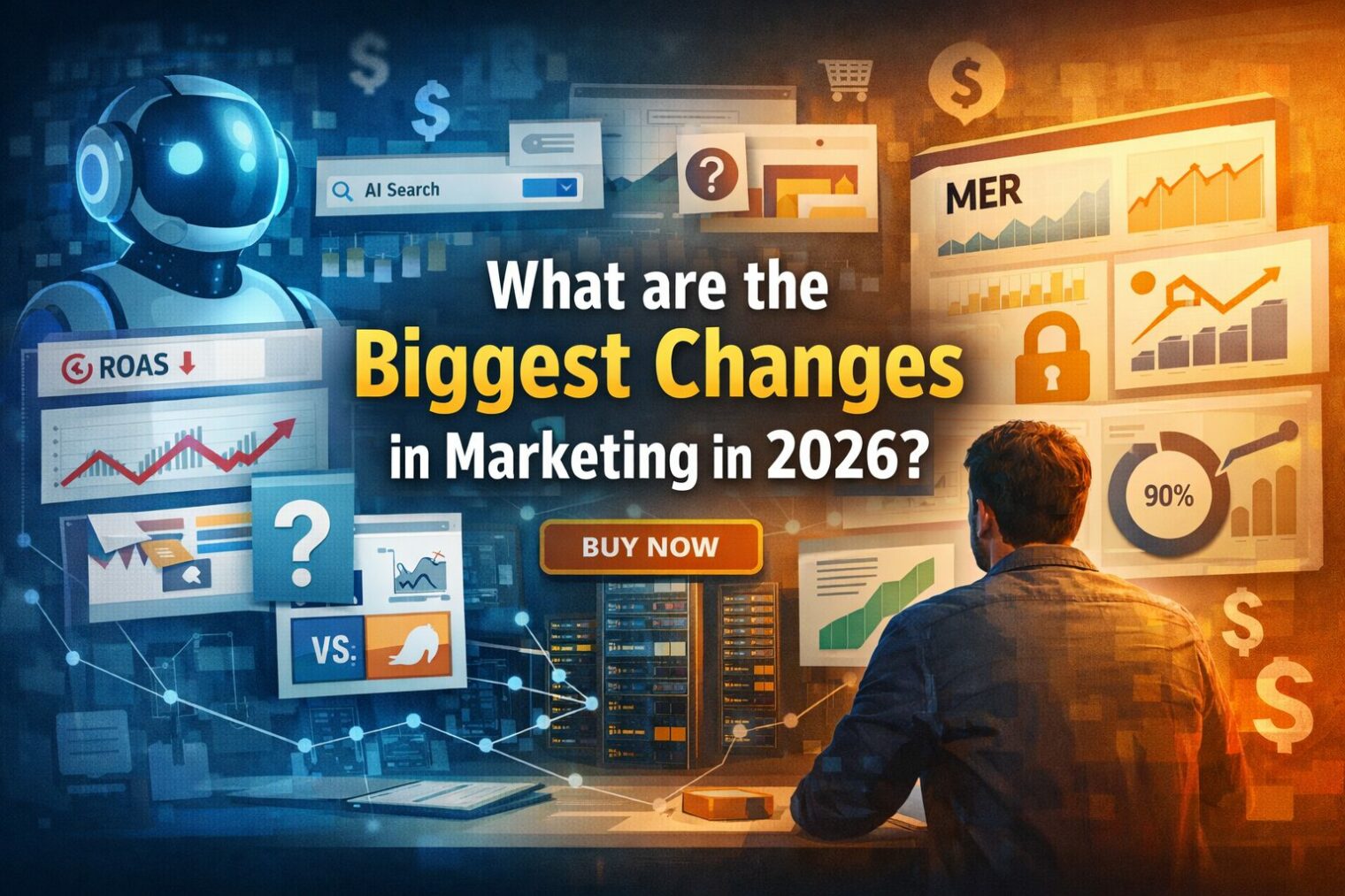
We’re already seeing major changes in e-commerce digital marketing in 2026.
Some of the most common tactics marketers have relied on for years are becoming less and less useful every day. If you’re not already adapting your marketing strategy to the tactics working now in 2026, it’s probably already affecting your revenue. You just haven’t realized it yet.
So what’s different from 2025 to 2026 in digital marketing?
- Keywords don’t work the same way.
- Creative is an entirely different process.
- Tracking and attribution barely resemble what they used to be.
- And anyone still treating ROAS as their primary success metric is almost certainly misreading what’s happening in their business.
This is the biggest shift in online customer behavior we’ve seen since mobile.
Here’s what’s changing and what we’re doing to help our brands stay ahead of it:
Do Keywords Still Matter for SEO?
Not the way they used to.
E-commerce SEO used to be like a math problem:
Keywords + Pages = Ranking
Rank = Traffic and Traffic = Sales
That model is changing, and fast. Even your grandma is using “The AI” for online shopping now, right?
Whether by choice – Asking ChatGPT what to buy the most handsome grandson for Christmas…
Or by force – The AI Overview that interrupts and takes up the top half of the Google SERP…
Search engines aren’t just sending shoppers to sites anymore. They’re answering questions for them.
Product comparisons, buying advice, and “which one should I choose?” questions are increasingly handled directly in search results, AI overviews, and LLMs.
That means ranking a page doesn’t automatically mean a shopper ever sees it.
If your content doesn’t clearly explain why a product is the right choice, it gets summarized, skipped, or ignored entirely.
You might still “rank.” But you don’t influence the decision.
How to Use Keywords Effectively in 2026
Instead of stuffing articles with individual keywords, we’re finding the questions customers are asking. We start with:
What decision is the customer trying to make?
What comparisons are they weighing?
What uncertainty is stopping them from buying?
Then we answer those questions in a way AI can cite.
If a piece of content doesn’t make a buying decision easier, it doesn’t matter how many keywords are in it.
How Will Content and Creative change in 2026?
One word: Speed.
We used to think speed came with a trade-off:
Moving fast meant paying more and watching quality suffer. But AI tools, faster production workflows, and better internal tooling mean the cost of creative dropped, production quality soared, and whether it’s video, static, motion graphics, or explainer videos, it all takes a fraction of the time it used to.
That means teams can:
- Produce more concepts in less time
- Test more variations with smaller budgets
- Iterate without long production cycles
So What’s the Secret to High-Performing Creative in 2026?
Stop trying to create one perfect ad.
The advantage now comes from learning faster without letting quality slip.
Our creative teams are now tasked with:
- Launching ideas earlier with clear hypotheses
- Testing angles and messages, not just formats
- Letting performance data (not guessing or opinions) decide what to scale
If you’re still treating every ad like a finished product instead of a testable hypothesis, you’ll always be reacting to results instead of driving them.
In 2026, the competitive advantage in creative isn’t having the best single ad in the account.
It’s building a system that learns faster than everyone else.
Why Does Your Tracking Feel Broken in 2026?
Because most of it is.
Browser pixels are unreliable now. They get blocked by:
- Safari/Firefox privacy rules
- iOS settings
- ad blockers
- cookie loss
- cross-device behavior
So platforms don’t “see” enough conversions to optimize correctly. You end up with undercounted revenue, weird attribution shifts, shrinking retargeting pools, and less stable performance.
Nothing looks obviously wrong at first. Numbers still move. Dashboards still populate. But over time, things stop lining up. Browsers, privacy updates, ad blockers, and platform restrictions have steadily reduced what client-side tracking can see.
As a result:
- Retargeting pools shrink
- Conversion counts drift
- Algorithms optimize against incomplete signals
The system still runs. It just runs worse.
The Only Way We Get Accurate Attribution Data for E-commerce Brands
Server-side tracking fixes attribution by sending conversion events from your server (or a server-side container) directly to ad platforms so the browser isn’t the single point of failure.
What it actually does (in e-commerce terms)
- Captures more purchases/ATCs/checkout events that pixels miss
- Sends cleaner conversion signals to Meta/Google so bidding optimizes better
- Keeps retargeting and value-based optimization healthier
- Reduces attribution gaps between platforms
- Makes performance trends easier to trust over time
It doesn’t make tracking perfect. Nothing does. But it restores enough signal for platforms to optimize and for teams to make decisions without guessing.
This is why we now implement server-side tracking for every e-commerce brand we work with, across nearly every service we offer. It’s the one infrastructure upgrade that 100% of customers agree on.
The improvement is immediate and obvious: cleaner data, more stable performance, and far fewer “why does this look wrong?” conversations.
Is ROAS Important Anymore?
For years, ROAS worked as a key metric because tracking was cleaner, customer journeys were simpler, and platforms could see most of what was happening. That’s no longer the case.
In 2026, ROAS disproportionately rewards the bottom of the funnel. Retargeting, branded search, and high-intent users get most of the credit, while the work that actually creates demand gets underrepresented or ignored entirely.
At its best, ROAS is a marketing metric.
MER and profitability are business metrics.
That distinction matters a lot more than it used to.
ROAS only tells you how ads performed in isolation, based on incomplete attribution and whatever the platform decided to take credit for. It says nothing about whether the business is actually healthier because of that spend.
You can have strong ROAS while:
- New customer growth slows
- Margins shrink
- Cash flow tightens
- Inventory piles up or runs out
Nothing looks wrong inside the ad account, but everything feels wrong everywhere else.
That’s why ROAS can’t be the primary decision-making metric anymore.
MER forces marketing out of its silo. It looks at total revenue relative to total ad spend and answers a more important question: Is marketing contributing to overall business growth, or just reallocating demand?
Once you start measuring marketing this way, other problems become obvious fast.
Marketing can’t just push whatever converts best in-platform. It has to push:
- Products that are profitable to deliver
- Products that are actually in stock
- Products the business wants to scale
Otherwise, you end up optimizing for a spreadsheet instead of the business.
MER and profitability don’t replace ROAS entirely.
They just put it in its place.
And in 2026, that’s the only way marketing actually works. If you need help updating your e-commerce marketing strategy to work in 2026, talk to a strategist.
Key Takeaways
- Keyword rankings alone no longer drive traffic or sales. Content has to help shoppers make a decision.
- SEO in 2026 is about answering real buying questions in a way AI can summarize or cite.
- Creative performance now comes from speed, testing, and iteration, not from perfecting one ad.
- Creative is cheaper to produce, but the bar for what works is much higher.
- Browser-based tracking is unreliable. Server-side tracking is now required to maintain usable data.
- ROAS should no longer be treated as the primary success metric.
- MER and profitability reflect how the business is actually performing.
- Marketing must align with inventory, margins, and business goals, not operate in a silo.
Frequently Asked Questions
Do keywords still matter for SEO in 2026?
Yes, but they are no longer the strategy. Keywords are inputs. Content needs to help shoppers decide.
How should e-commerce brands approach SEO now?
Focus on comparisons, use cases, and tradeoffs that reduce uncertainty and guide buying decisions.
Why is speed so important for creative now?
Because production is faster and cheaper, competition is higher, and brands that learn faster outperform those that over-polish.
Why does tracking feel less reliable?
Browser pixels are blocked more often, which leads to missing conversions and weaker optimization signals.
Is server-side tracking necessary?
Yes. It restores enough signal for platforms to optimize and for teams to trust performance trends.
Is ROAS still useful?
ROAS is still useful, but it should not be the primary metric. It only shows performance inside the ad platform.
Why is MER more important in 2026?
MER ties marketing performance to total revenue and forces alignment with profitability, inventory, and growth goals.
How should marketing teams decide what to promote?
Marketing should prioritize products that are profitable, in stock, and strategically important to the business.




no replies