



There are levels to generating UGC content. What are the different tactics and how to execute each one.
The short version
- UGC works as a tier system, running from the marketplace, to creators you find yourself, to your actual customers, and each tier is harder to build and lasts longer than the one underneath it.
- The tier you need depends on your brand, so sort yourself onto a 2×2 of ticket price and SKU count before you buy anything.
- Tier 1 is the easiest and obvious, Tier 2 is where most agencies stop, and Tier 3 is the slowest to build but the most durable thing you can own.
In this piece
- The brand quadrant comes first
- Tier 1 – the marketplace tier
- Tier 2 – the discoverable creator tier
- Tier 3 – the actual-fan tier
- The system layer
- What to actually do
- The 90-day starter sequence
The customer list ah-ha moment
Pull up your customer list. Somewhere in that list is someone with a bigger audience than many creators you ever worked with from Billo. You almost certainly haven’t noticed them.
We hadn’t either. We were running ads for an American flag company when our enrichment software flagged something we’d been missing. Lindsey Baldwin a creator with over 134k followers, had bought a flag in the spring. Three rows down was the wife of an NFL head coach. Both had been customers for months, and we were missing this for clients.
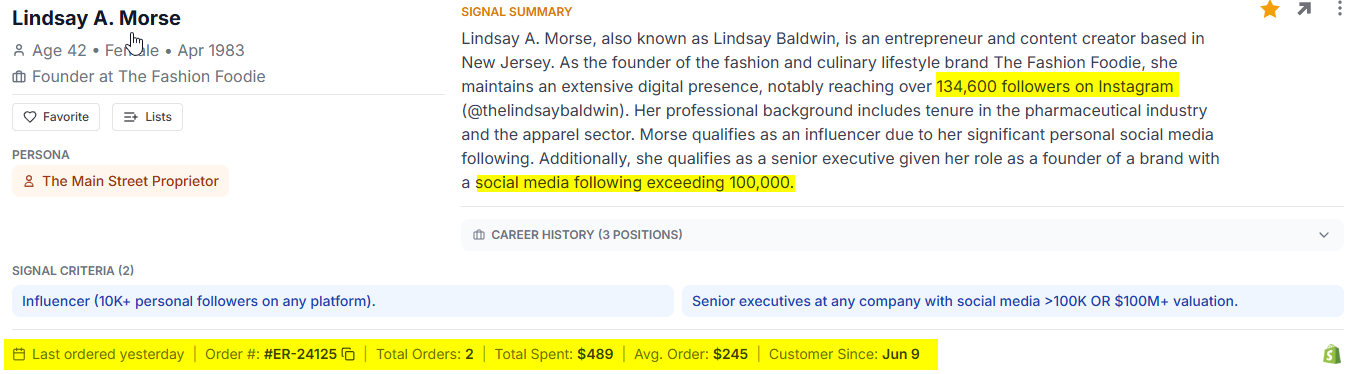
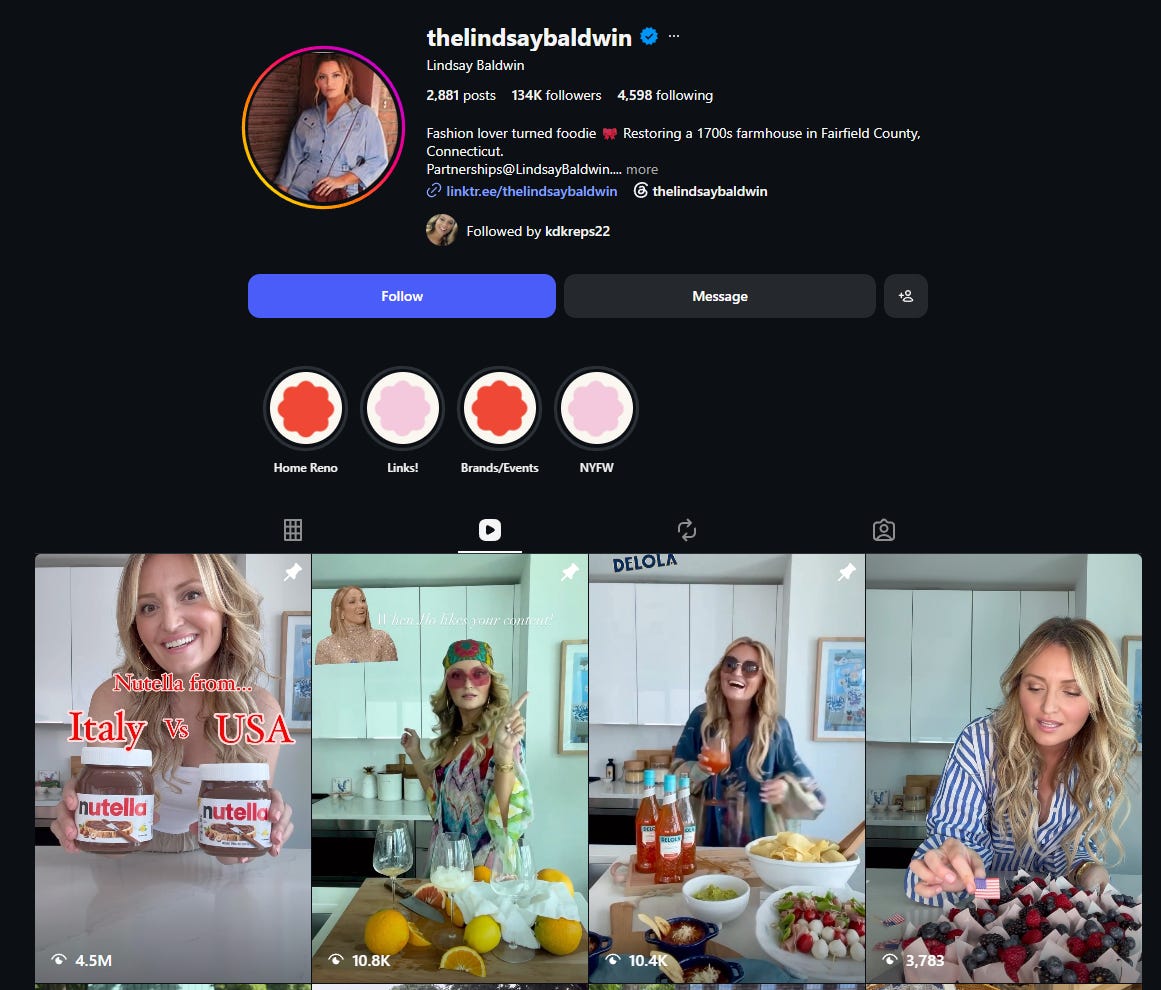
That report changed how we treated UGC for every client after.
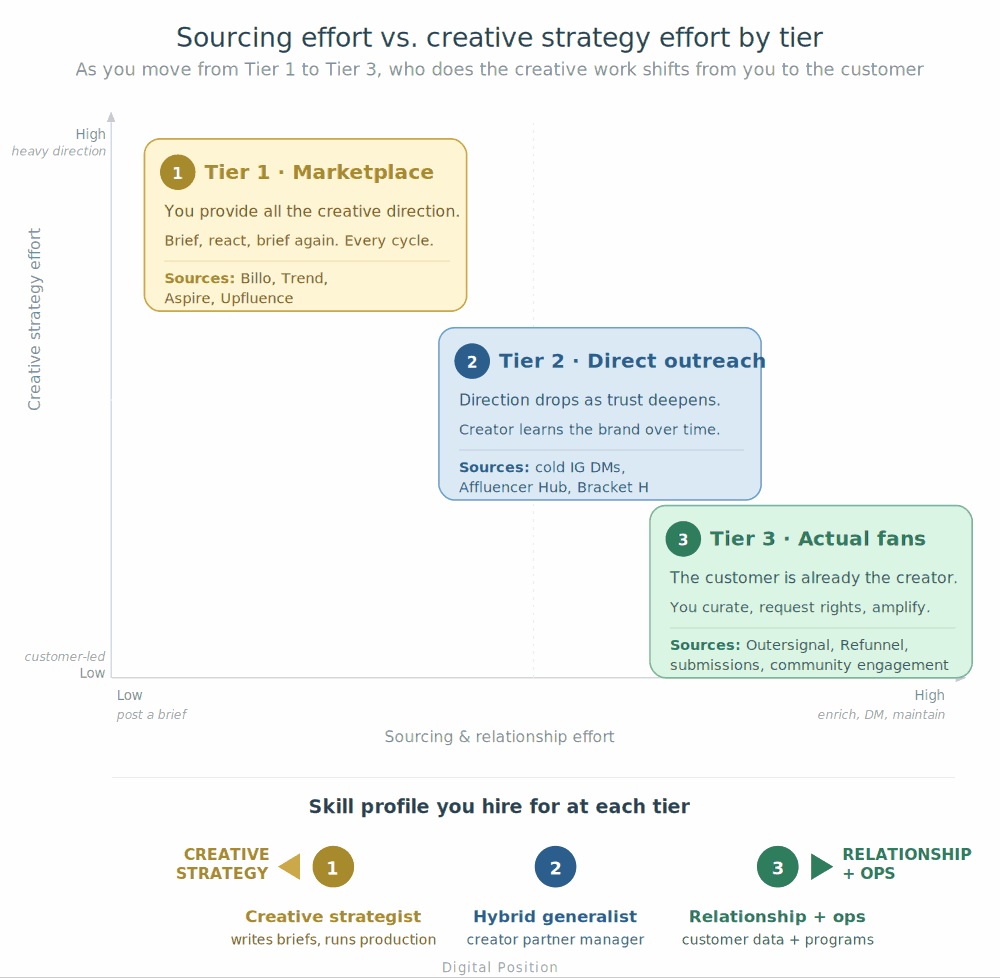
Most UGC strategies we audit have the same flaw. They buy creators by the unit instead of asking what kind of creator the brand needs. UGC works as a tier system. The tier you need depends on the kind of brand you run. Most people only use marketplaces.
The UGC on a $19 snack ad and the UGC on a $700 purse have almost nothing in common, yet most brands still buy them like the same thing.
The brand quadrant comes first
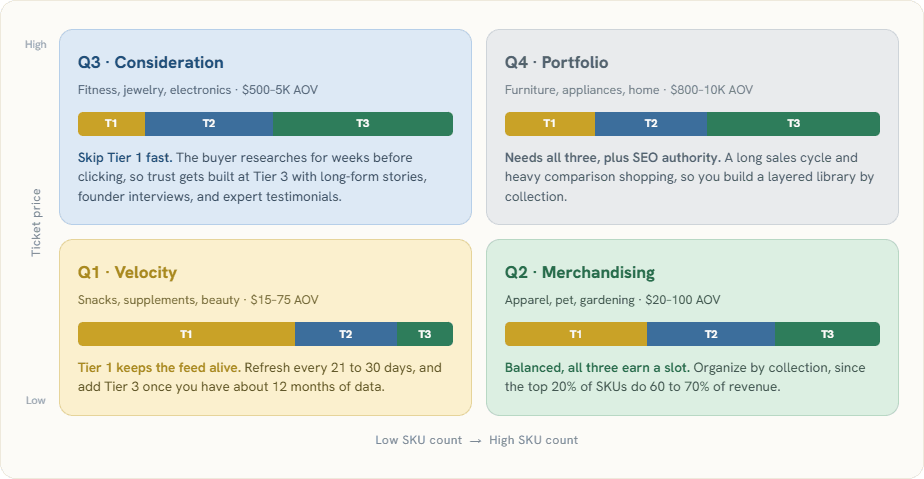
Before you spend another dollar on UGC, sort yourself onto a 2×2 of ticket price and SKU count. The corner you land in tells you a lot before anyone says a word about creators.
- A snack brand at $25 AOV with 4 SKUs lives in one corner (Q1, velocity).
- A jewelry brand at $2,500 AOV with 30 SKUs lives in another (Q3, consideration).
- A furniture brand at $5,000 AOV with 800 SKUs lives in a third (Q4, portfolio).
- Anything in the 50 to 500 SKU range at modest ticket prices, like apparel, pet, and gardening, sits in Q2 (merchandising).
Each corner has a different creative job.
- A velocity brand needs fresh content every 21 to 30 days because the audience burns out fast.
- A consideration brand needs deep, trust-building content because the buyer is researching for weeks before they click.
- A merchandising brand needs creative that surfaces the top 20% of SKUs, the ones doing 60 to 70% of revenue.
- A portfolio brand needs SEO authority and product-level depth because the shopper is comparing five competitors at once.
The type, length, channel, and refresh rate of your UGC all change depending on the corner you’re in. Before anyone tells you which tier you need, they should ask which corner you live in.
Tier 1: The Marketplace Tier
Tier 1 is where everyone starts, and you already know the names: Billo, Trend, Aspire, Upfluence. You post a brief, creators apply, you ship product, and you get videos back for $250 to $500 a piece, with a standard package running around $4,000 for 3 to 5 videos. This tier is perfectly fine, and it’s easy for any brand running paid social.
Where Tier 1 proves value:
- Volume, and filling the testing pipeline so you always have something fresh to run.
- Static-style problem/solution scripts that hook fast.
- Velocity brands that need a fresh face in the feed every few weeks.
- Founders who haven’t yet built anything resembling a creator program.
Where Tier 1 starts to fall short:
- High-consideration buyers, because a $5,000 product needs more than a 22-year-old in their bathroom telling you they “love it so much.”
- Brands can’t select random creators and give them free product
- Creator recycling, since the good marketplace creators are now showing up in ads for 12 other brands you’ve also seen.
- Shelf life, because these videos go stale in 30 to 60 days once the algorithm has shown them to your audience too many times.
If you stop at Tier 1, you’ll spend a year wondering why UGC isn’t working anymore, when it’s working exactly as well as it ever did. You’ve maxed out the version of it you bought.
If you stop at Tier 1, you’ll spend a year wondering why UGC stopped working, when really you’ve just maxed out the version of it you bought.
Tier 2, the discoverable creator tier
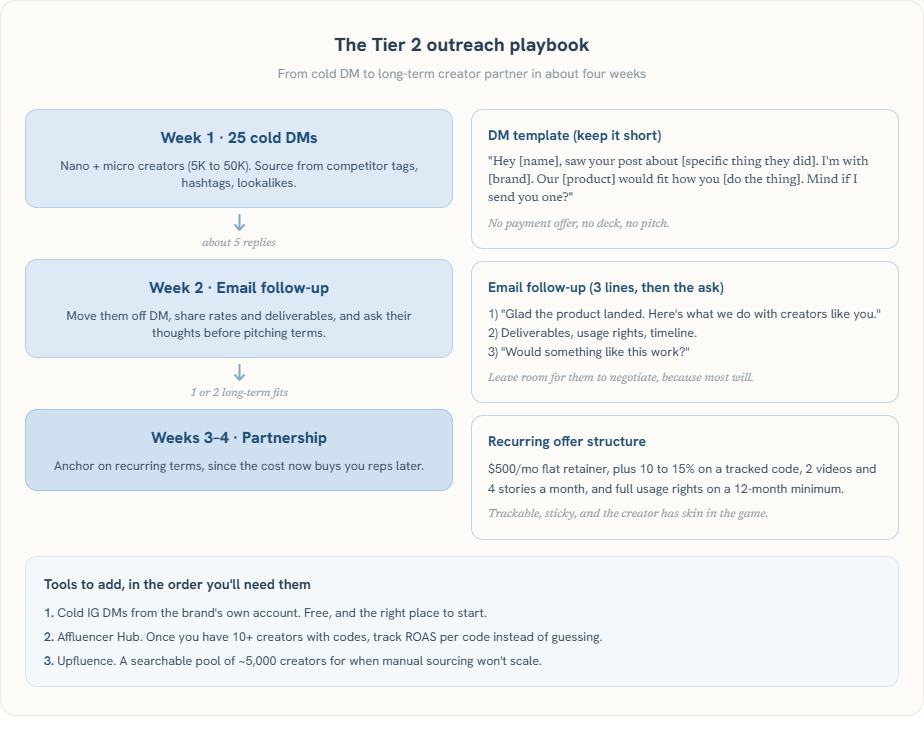
Tier 2 is the same kind of creator, sourced differently. You skip the marketplace and go direct. Pick a brand on Instagram, pull the 25 nano and micro creators whose audience overlaps with yours, and cold DM all 25. About 5 will reply, so you follow up by email. The 1 or 2 who really fit, you build a relationship with.
Why bother going direct? Two reasons. Marketplaces filter by surface-level criteria, like follower count, niche, and sometimes location. They struggle to filter for “person whose lifestyle matches the brand.” Going direct lets you do exactly that. You also cut out the marketplace fee, so the same $250 buys you a better creator, or a longer-term relationship instead of one drop-and-go video.
A few tools make this tier easier to run. Affluencer Hub tracks influencer revenue by coupon code, and if you’re sending product to 30 creators a month, you have no idea who’s actually moving units without something like it. Upfluence’s creator community gives you a searchable pool of around 5,000 creators with marketplace fees stripped out, useful once manual sourcing slows you down. If you’re tight on budget, the one-influencer-plus-affiliate model works: $500 a month flat to your single best creator plus 10 to 15% commission on a tracked code. Now the creator has skin in the game to figure out how to connect with your customer.
Where Tier 2 proves value:
- Better ROI per dollar than marketplace
- Identify stronger matches and brand fit by content and personality
- Affiliate style attribution, longer term relationships, deeper creative strategy
Where Tier 2 struggles:
- Slow to first content. Sourcing 25 creators, DMing all of them, qualifying the replies, and converting 1 or 2 takes 3 to 4 weeks before any video gets created.
- Each Tier 2 partner needs hands-on management. 5 or 6 active partners is the realistic cap before you need agency support
Tier 3, the actual-fan tier
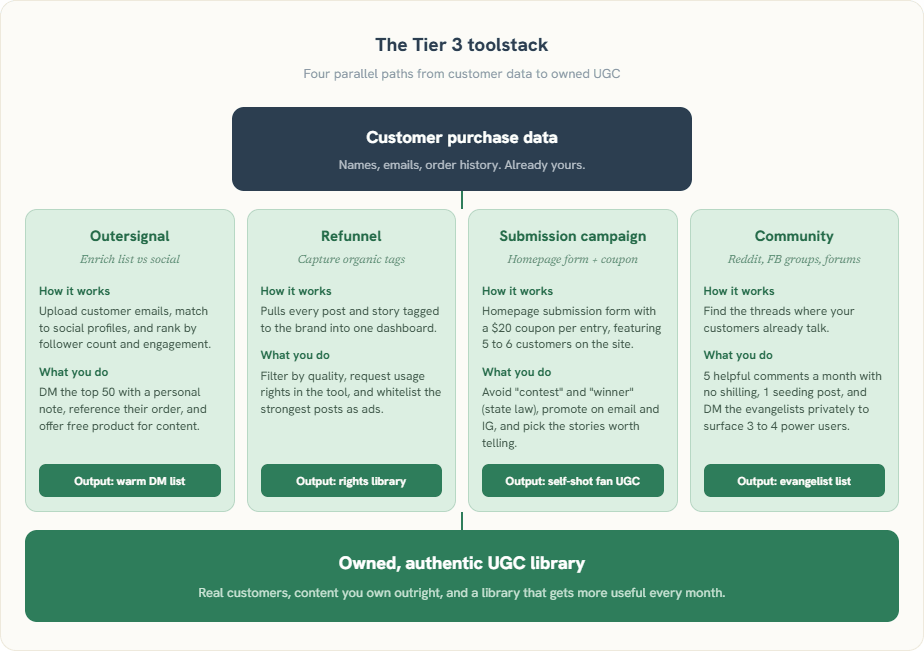
Tier 3 is the tier most agencies skip, and the reason is the data lift. Tier 3 means content from your real customers who happen to have an audience already, and you can’t get there without enrichment, tooling, and a willingness to do work that doesn’t pay off for 60 to 90 days. Here’s what the workflow looks like for us in practice.
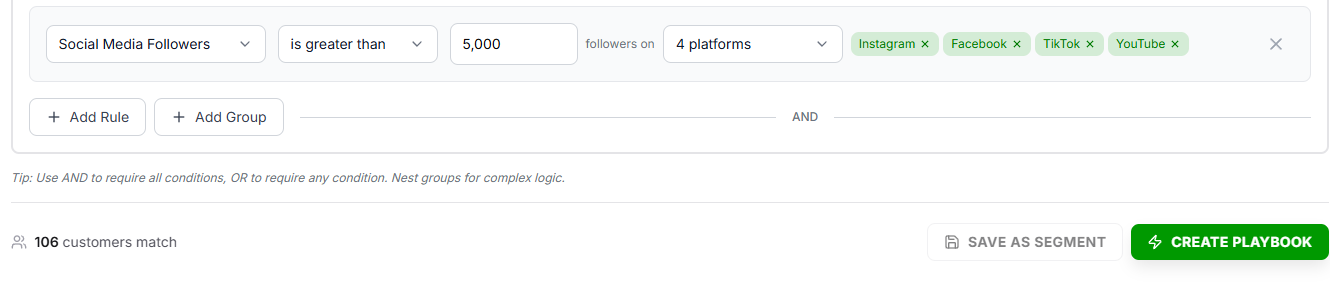
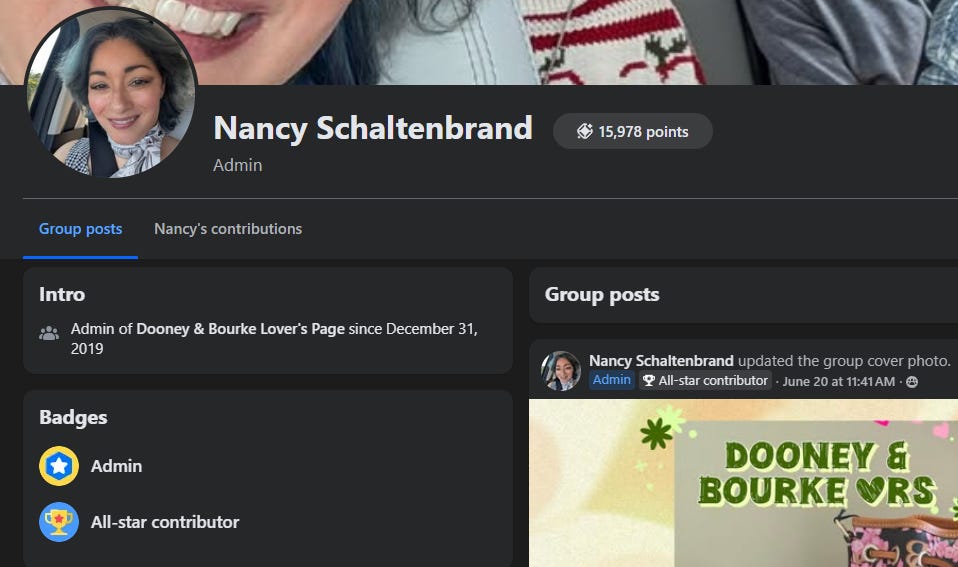
Outersignal. We enrich every client’s customer list against social data, and the list comes back ranked by follower count and engagement. The CAVA cofounder showed up here. So did the NFL coach’s wife. The DM you send those people lands differently than a cold pitch to a random creator, because they already paid you money. They already love the product. You’re approaching someone who already chose you, and asking whether they’d like to do it on a bigger stage.
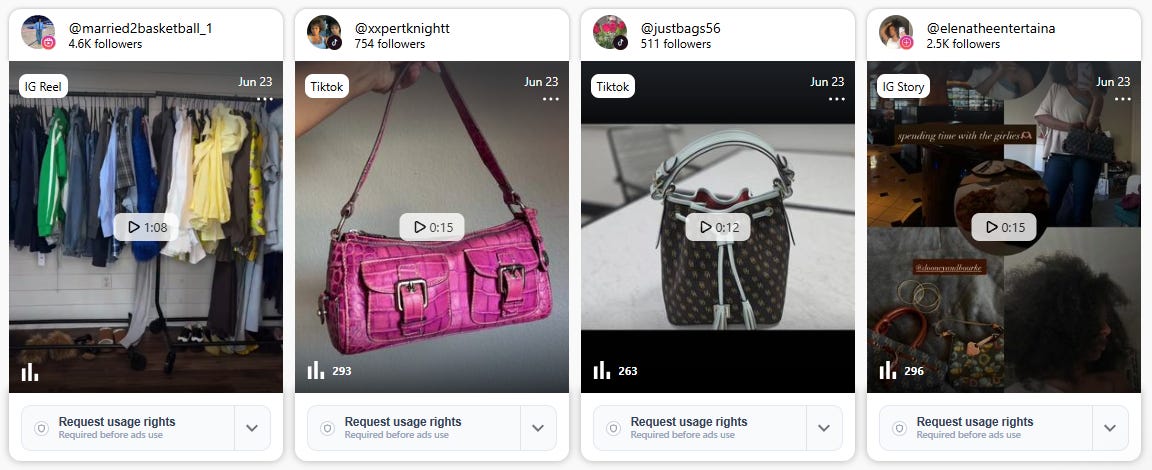
Refunnel. For brands with high organic tag volume, and Dooney gets tagged thousands of times a month, Refunnel pulls every tagged post and story into one place, lets you request usage rights inside the tool, and lets you whitelist the post as a paid ad. The content is from a real customer, and you’re stacking paid reach on top of it.
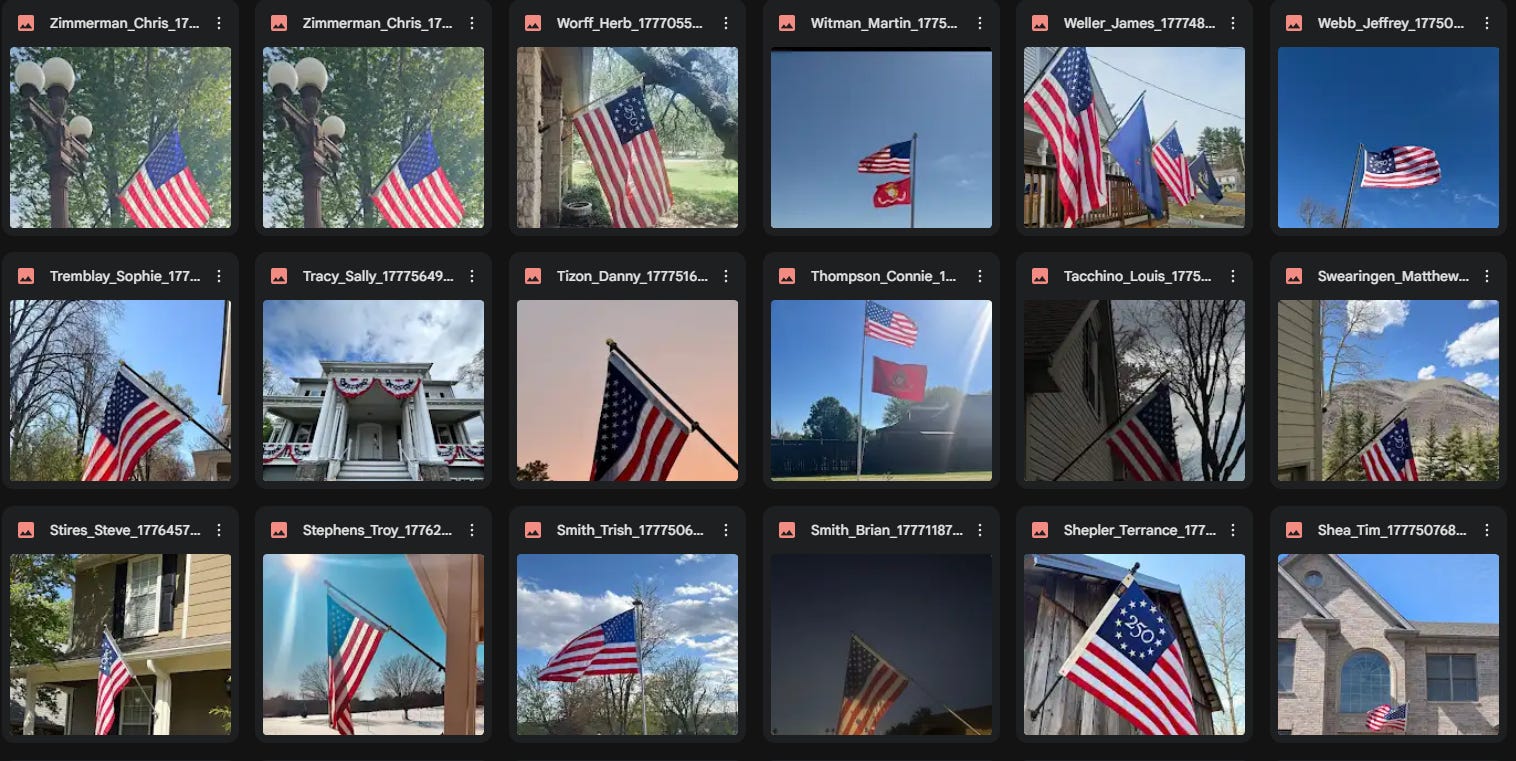
Submission campaigns. One of our clients sells American flags. We ran a “Fly With Us” campaign built on a homepage submission form, a $20 coupon for submitting a photo, and six selected customers featured on the homepage with their story. Total spend, all in: $650. The submissions came in from people with drone footage, semi-pro photography setups, and regular customers shooting on their phones over a Saturday morning. We carefully avoided the words “contest” and “winner” because state-level promotional law is a minefield. The output was the kind of authentic content you cannot buy on Billo for any amount of money.
Forum and community engagement. Reddit, Facebook groups, and brand-specific fan clubs are worth treating as creator-discovery surfaces. A cadence of 5 engagements per month plus 1 seeding post is small enough that the community doesn’t flag it as marketing, and the right post will surface 3 or 4 people you didn’t know existed who already evangelize the brand for free. Every brand has a handful of die-hard fans who promote the products without being asked. A lot of them are already making their own content because they love it that much. These are the people who know the tips and tricks, how to spot a fake, and the best use cases the marketing team usually misses. Once you find them they’re worth far more to you than any cold creator.
Where Tier 3 proves value:
- Content depth is higher quality and now works for consideration and portfolio brands. When the buyer is comparing competitors for weeks, customer content does work no marketplace creator can match.
- Your competitor can buy the same Billo creators. They cannot buy your customer list.
- High chance of content being able to repurpose on other channels. Website, email, and more.
Where Tier 3 might not be the best fit:
- Takes 60-90 days to get first pieces of content so needs to be part of a mature creative engine
- Brands that don’t have many customers to enrich or talk about the brand on their own
- Refunnel needs 100+ organic tags for it to be worth it
- Needs workflow integration across customer data, enrichment, briefs, and measurement.
The UGC Content System
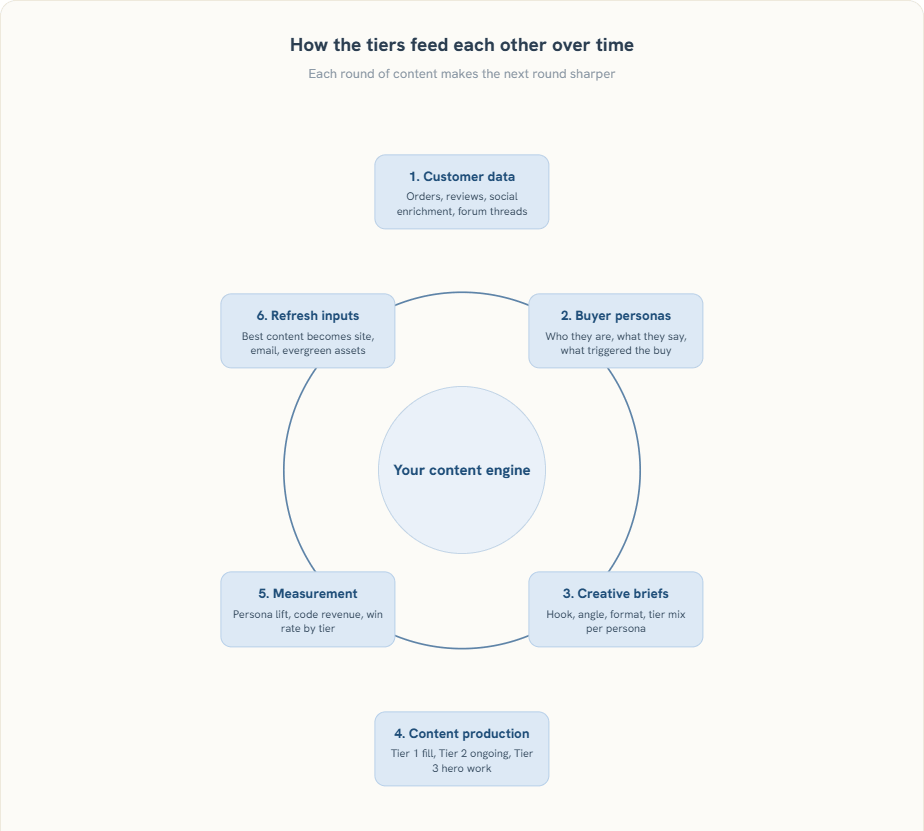
If you want to know what the most successful brands are doing with UGC, here’s the shape of it. Customer data flows into Outersignal and your reviews tool. Outersignal, Forum top contributors, and the strongest reviews identifies the customers who are also creators. Your reviews, Reddit threads, and competitor reviews surface the exact language those customers use to describe the product. Both feed your buyer personas. The personas feed your creative briefs. The briefs feed the content, with some Tier 1 for fill, some Tier 2 for ongoing programs, and some Tier 3 for the hero work. The content runs against the personas, the persona lift gets measured, and the data feeds right back in at the top.
There’s a cheaper version to start with: the ai-static to UGC to evergreen pipeline. You generate AI-styled statics as the cheapest possible test layer, where the ones that work move into human executed graphic design. The angles that work become UGC scripts. The UGC that works gets repurposed into evergreen site content, email creative, and mid to high produced ads. Each layer earns its way to the next.
What to actually do
Pick your tier based on the brand you have today.
If you’re a velocity brand under $75 AOV, Tier 1 plus Tier 2 works. Refresh every 21 to 30 days and add Tier 3 once you’ve got 12 months of customer data worth enriching.
If you’re a merchandising brand with a big catalog, Tier 1 works for lower ticket items, Tier 2 covers your seasonal pushes, drops and larger products, and Tier 3 builds the brand-identity content that is needed for a deeper connection.
If you’re a consideration brand over $500 AOV, Tier 1 alone will fail. Lean on Tier 2 as your baseline. Put the work into Tier 3 because partnerships are more important and depth of content matters.
If you’re a portfolio brand with 500+ SKUs and a long sales cycle, you need all three, plus the SEO and consultative layer that lives outside the scope of this piece.
The 90-day starter sequence
If you’re at zero today and want to build the full tier stack from scratch, here’s the order I’d run it in, and roughly what each month costs you.
DAYS 1–30. Run Tier 1. Pick one marketplace (Billo is the easiest). Brief 5 creators against 10 distinct angles. Budget $1,500 to $2,500. Use the output to fill the static testing pipeline and find the 2 angles that hook hardest.
DAYS 31–60. Add Tier 2. Build a list of 25 nano and micro creators on IG. DM all 25 in week one (the template is in the image above). Email the ~5 who reply. Convert 1 or 2 into the $500/month plus commission retainer. Now you have a steady creative input that isn’t marketplace-dependent.
DAYS 61–90. Stand up Tier 3. Run Outersignal on your top 1,000 customers and you’ll find at least 10 with real audiences you didn’t know about. Decide whether Refunnel is worth it based on your monthly tag volume (under 100 tags a month, skip it for now). Sketch the first submission campaign and pick a launch date.
By day 90 you’ve got Tier 1 in production, Tier 2 with one or two recurring partners, and Tier 3 with a seed list and a campaign in flight. Lean cash spend comes in under $6,000. Tooling runs roughly $400 to $800 a month depending on which paid tools you choose.
Three things to remember
If you read nothing else, take these:
- The tier you need is downstream of the brand you run. Sort yourself onto the quadrant before you spend another dollar on UGC.
- Tier 1 is rented. Tier 3 is owned. Marketplace videos are creative you license for 30 days. Customer videos are relationships you keep, and the relationships keep producing.
- The goal is Tier 3. Most brands never get there because the work takes months to produce, and they quit at day 10. It also requires work and relationship building. Most people will give up.



no replies