



GEO (Generative Engine Optimization) is how you get your brand cited inside AI-generated search answers. Here’s what it is, how it works, and what to do about it.
How you and everyone else is searching
If you’ve been watching your organic traffic tank or even flatten out over the past year, you’re not alone.
More and more, someone types a question into Google and gets a synthesized answer at the top of the page before they ever see a list of websites. ChatGPT and Perplexity have become go-to research tools for millions of buyers. Even Bing has an AI co-pilot built right into the browser.
These tools don’t just rank pages. They generate answers and cite the sources they pulled from.
That shift is what generative engine optimization (GEO) is about. If you want to stay visible to customers who are searching for what you sell, GEO is something I am going to break down and help you understand.
What is generative engine optimization?
Generative engine optimization (GEO) is the practice of structuring and writing content so that AI-powered search tools cite your brand in the answers they generate.
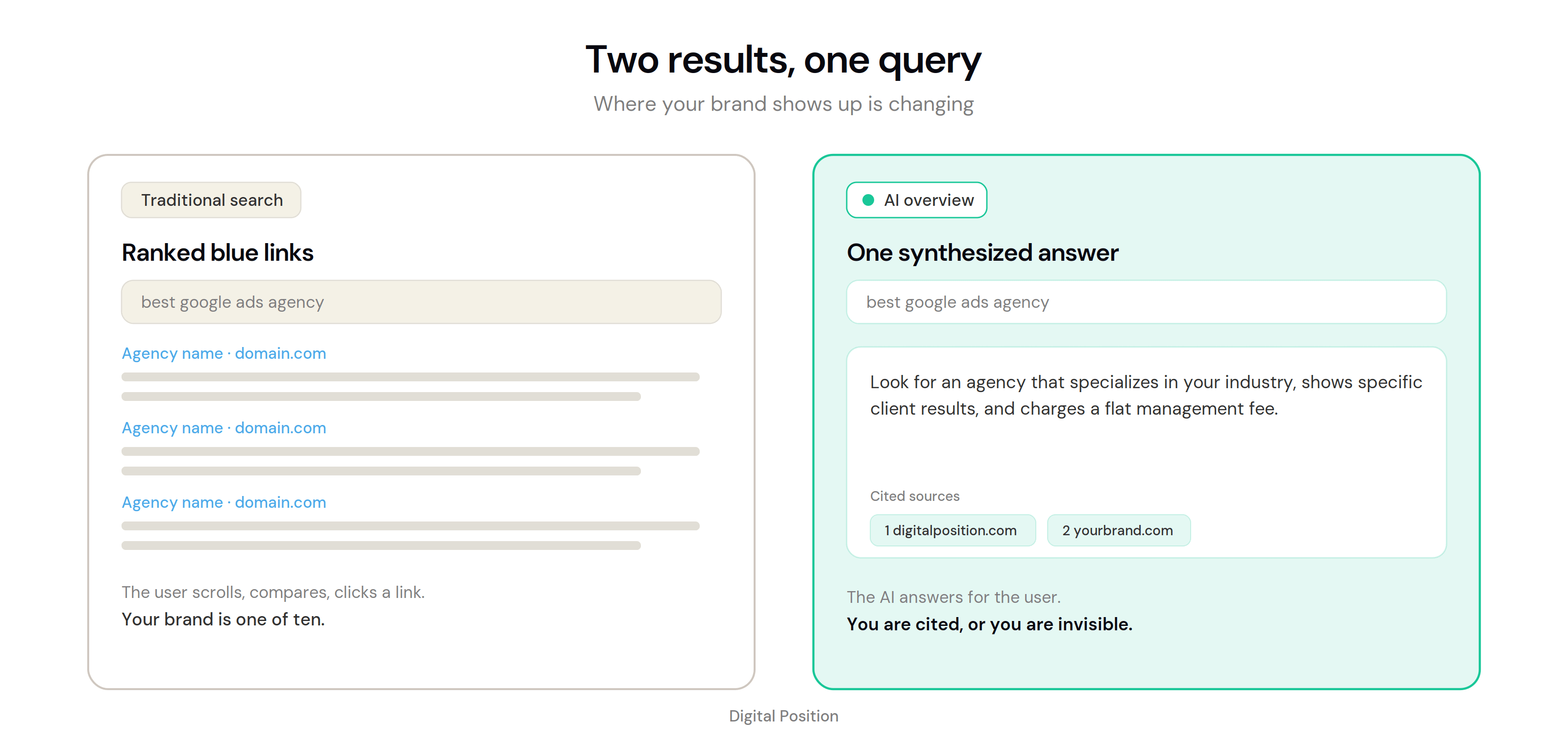
When someone asks Google “what’s the best marketing agency for ecommerce brands,” Google’s AI Overview reads dozens of sources, synthesizes a response, and picks 2 to 4 of those sources to credit. The same thing happens in ChatGPT, Perplexity, and Gemini.
GEO is about being one of those credited sources consistently, for the topics that matter to your business.
It’s related to traditional SEO, and it shares a lot of the same foundation. But the goal is different. SEO gets your page into a ranked list. GEO gets your content pulled into the answer itself.
Why this matters if you’re running a $1M–$10M business
If you are a larger brand, you likely already have this on your radar, have a good brand presence, and show up in AI overviews.
In this range you are trying to be scrappy, haven’t prioritized AEO/GEO/SEO or you don’t know where to begin.
Here’s the problem that shows up regularly for growing brands: you’re competing against companies with bigger budgets, more staff, and more content. Ranking on page one is slow and expensive.
But AI search has changed the competitive math a little.
AI tools don’t just cite the biggest domains, they cite the most specific, most trustworthy, most directly useful content. A well-written, expert-level page from a smaller brand can get cited ahead of a thin page from a Fortune 500 site if it actually answers the question better.
That’s where you can start, but you have to know what AI is looking for.
SE Ranking tracked over 3 million search queries in 2025 and found that Google AI Overviews appeared in about 47% of them. For informational queries in industries like marketing, ecommerce, finance, and health, that number is even higher. If your content isn’t structured for AI retrieval, you’re invisible for close to half of all relevant searches.
How GEO is different from traditional SEO
Think of them as two layers of the same thing.
Traditional SEO gets your page into the index and ranked. It’s about domain authority, backlinks, keyword optimization, and technical site health. You still need this but it may move on your prioritization list depending on the type of business you run. I’ll get explain more about this later.
GEO adds a layer on top of that. It’s about how your content is structured and written, so that when an AI reads it, the AI can pull a direct, quotable answer from it. AI tools are trying to answer a specific question. Content that makes that job easy gets cited.
The practical difference comes down to a few things:
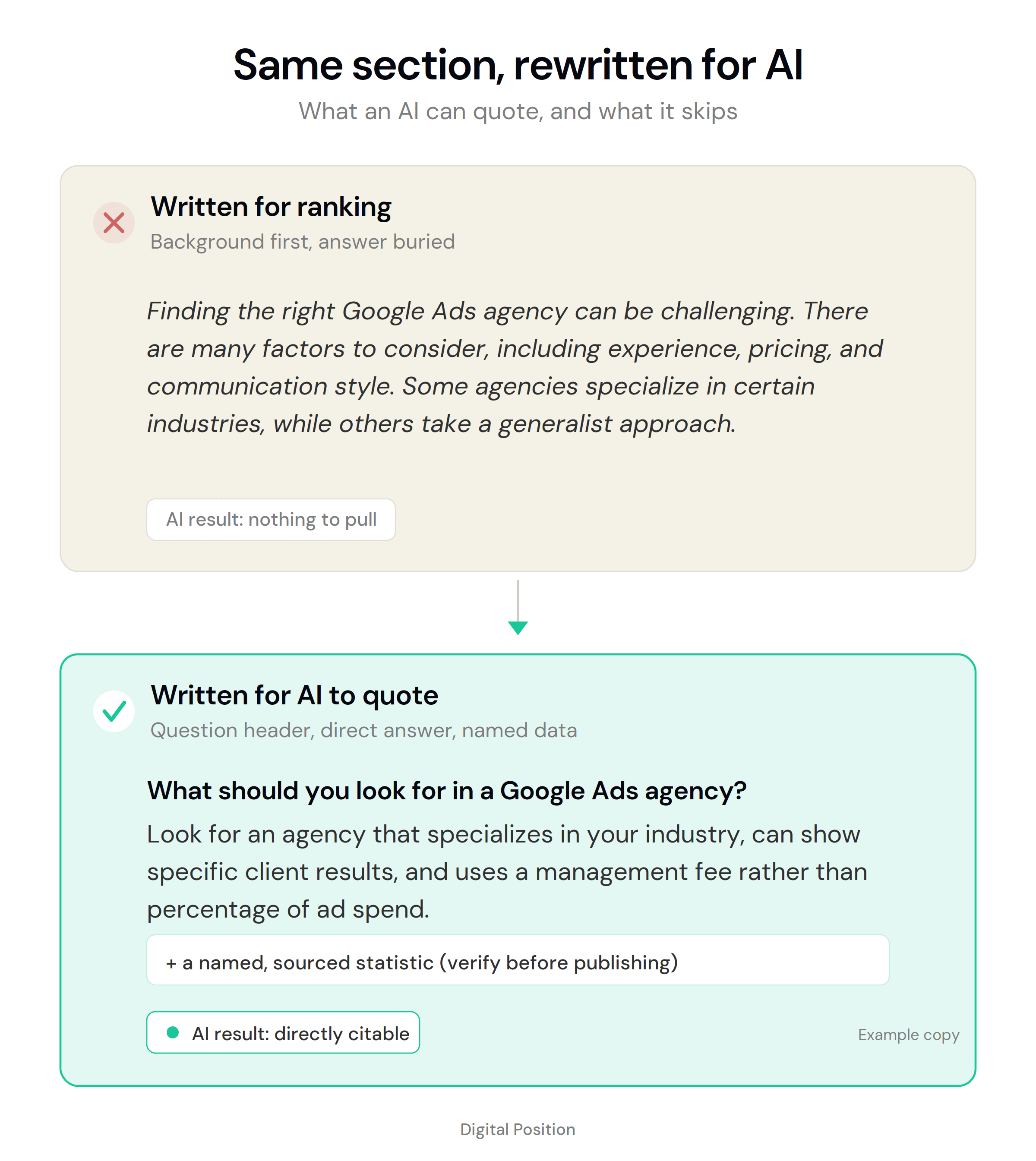
Traditional SEO content might start a page with 3 paragraphs of background context before getting to what the reader actually wants to know.
GEO-optimized content answers the question in the first sentence. Then it backs it up.
Traditional SEO measures success by rankings and clicks.
GEO also tracks how often your brand is cited in AI-generated answers, and whether AI referral traffic is showing up in your analytics.
The 4 signals AI uses to decide who to cite
When an AI tool decides which sources to pull into its response, it’s looking for a few consistent things. These have been documented across studies of Google AI Overviews and Perplexity citation behavior:
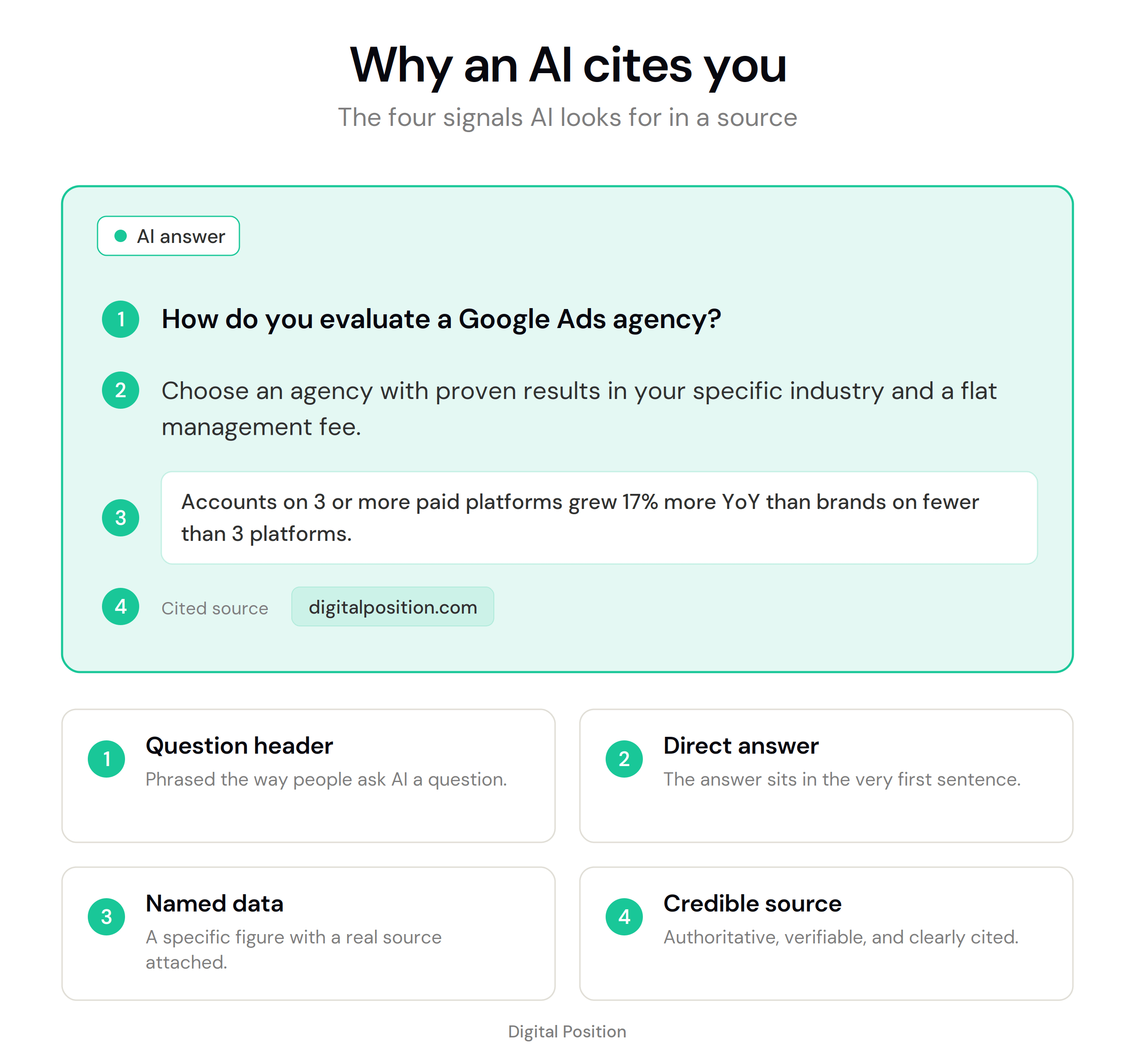
1. Direct, specific answers. Content that answers the question in the opening sentence gets cited far more often than content that takes a while to get there. A study from Columbia University found that adding direct-answer summaries to content improved AI citation rates by up to 40%. Hint – FAQs
2. Named, verifiable data. “Many businesses see improved results” is not citable. “According to Baymard Institute’s 2026 research, 70.19% of ecommerce carts are abandoned before checkout” is. Specificity with a source attached is what AI likes to quote.
3. Credibility signals. AI tools favor content from sources that have demonstrated authority on a topic over time. That means a real author with credentials, a domain that publishes consistently on a subject, and content that other credible sites have referenced.
4. Structural clarity. Headers phrased as questions. FAQ sections with short, direct answers. Numbered steps for how-to content. These structures help AI parse which part of your content answers which type of query.
What GEO actually looks like in practice
Here’s a concrete example of the difference between content written for traditional SEO and content written with GEO in mind.
Say you’re writing a page about choosing a Google Ads agency.
Without GEO optimization:
“Finding the right Google Ads agency can be challenging. There are many factors to consider, including experience, pricing, and communication style. Some agencies specialize in certain industries, while others take a more generalist approach…”
An AI reading that won’t pull it. There’s no direct answer to cite.
With GEO optimization:
What should you look for in a Google Ads agency? Look for an agency that specializes in your industry, can show specific client results (not just case study vignettes), and uses a management fee structure rather than percentage of ad spend. According to HubSpot’s 2026 Marketing Agency Report, brands that evaluated agencies on proven vertical experience were 2.3x more likely to report strong ROI within 90 days.
The AI can quote that. It’s specific, it’s direct, and it cites data.
Every section written as if an AI will pull one paragraph from it to answer someone’s question.
GEO terms you’ll see referenced
A few related terms come up a lot when people talk about this space:
AEO (Answer Engine Optimization): The content strategy within GEO focused specifically on direct-answer formatting, FAQ structure, and question-based headers. AEO is what you do in the content. GEO is the broader strategy that includes AEO plus off-site authority-building.
AI Overviews: Google’s feature that places an AI-generated summary at the top of search results before the ranked links. Introduced broadly in May 2024, now appearing on nearly half of all queries in many industries.
Entity optimization: Making sure your brand is recognized as a distinct entity by AI systems, not just a collection of pages. This involves consistent name/address/phone data, verified profiles on authoritative platforms, and mentions across credible sources.
For a deeper breakdown of how GEO compares to traditional SEO, see: SEO vs GEO: What’s the Difference?
What to do this week (actionable starting points)
You don’t need to rewrite your entire site or blog. Start with these:
1. Add a “quotable definition” block to your top 10 pages. In the first 100 words of each page, include a 2-3 sentence direct answer to the primary question the page covers. Write it as if it might appear in a dictionary.
2. Test your content in AI right now. Go to ChatGPT, Perplexity, and Google (check for an AI Overview). Type the main question your top 5 content pages are supposed to answer. Is your brand cited? If not, that’s exactly what to fix.
3. Turn your headers into questions. If your post says “Agency Selection Criteria,” change it to “What should you look for when choosing a marketing agency?” This is a quick edit that significantly improves AI match probability.
4. Add a FAQ section to every major page. 5 to 8 questions with short, direct answers. Each answer should be 2 to 4 sentences. This is the single highest-impact format change for AI citation.
5. Add your publication date and a “Last updated” note to key pages. AI tools favor fresh content, especially for fast-moving topics. Dates are a signal.
None of these require a developer. A competent writer and a couple of hours per page is enough to get started.
How Digital Position approaches GEO for clients
We’ve been watching AI search behavior closely since Google’s AI Overviews launched, and we started building GEO into client content strategies before most agencies had a name for it.
What we’ve found in practice: ecommerce and B2B service brands that implement GEO alongside their existing SEO work see AI referral traffic grow meaningfully within 3 to 6 months. One client in a competitive vertical grew AI-attributed traffic by over 1,800% after a structured content overhaul, documented in this case study.
The work isn’t magic. It’s structure, specificity, and consistency. Any brand with real expertise can do this. The question is whether you’re doing it before your competitors are.
Also relevant: How to Get Your Ads to Show in Google AI Overviews and How to Fix Your Brand Reputation in 2 Hours with AEO
→ Talk to a Digital Position about your organic strategy
Frequently asked questions
What is generative engine optimization in simple terms? GEO is how you make your content show up inside AI-generated answers. When someone asks ChatGPT or Google a question, an AI reads a bunch of sources and writes a response. GEO is about making your content the source it pulls from.
Is GEO the same as SEO? They overlap but they’re different goals. SEO gets you ranked in a list of links. GEO gets you cited inside the AI answer that appears before those links. You need both. A strong SEO foundation makes GEO much more achievable.
Does GEO work for smaller brands? Yes, and this is one of the few places where smaller brands can compete effectively against larger ones. AI tools don’t just cite the biggest domains. They cite the most directly useful content. A specific, well-structured page from a $2M brand can outperform a thin page from a Fortune 500 if it’s better written.
How long does it take to see results from GEO? Faster than traditional SEO. AI systems continuously update, so well-structured content can begin showing up in AI answers within a few weeks. Sustained visibility requires consistent publishing and regular content updates.
What’s the first thing I should do to start with GEO? Run a test. Go to ChatGPT and Perplexity, type in the questions your best customers ask most often, and see who gets cited. If it’s not you, read the sources that do get cited. Notice what they have that yours doesn’t. That tells you exactly where to start.



no replies