



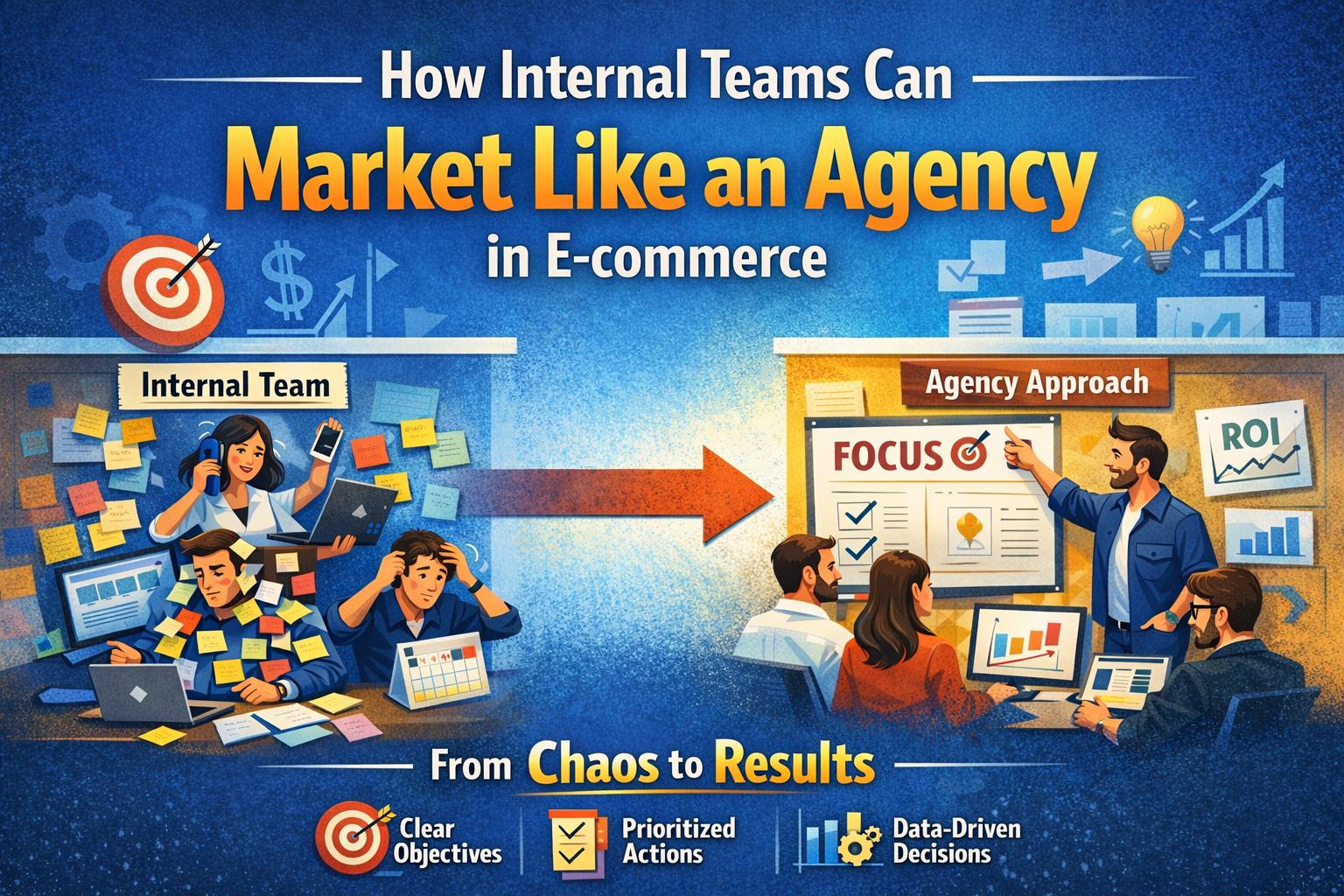
The biggest difference between the marketing results professional agencies achieve and the performance an average internal team can pull off has little to do with the creative we output.
It’s mostly structural:
How decisions get made.
What gets prioritized.
And what doesn’t get worked on even when the CEO’s professional YouTuber nephew is sure that it’s a good idea.
Here’s the framework our team is following in 2026 to manage high-performance marketing for brands doing $500k+ in monthly sales:
Find the One Thing Holding Your Marketing Performance Back
Every brand has some limiting factor they’re dealing with.
- Sometimes it’s margin.
- Sometimes it’s a single product carrying too much revenue.
- Sometimes it’s paid efficiency flattening.
- Sometimes it’s internal capacity.
One client came in convinced their problem was “Meta fatigue.” After digging in, it was obvious the real issue was that 70% of revenue was riding on a single hero SKU.
Our planning starts by identifying that constraint and agreeing on it explicitly. Once it’s named, it becomes the decision filter for the quarter.
Ideas, channels, and initiatives are evaluated based on whether they relieve pressure on that constraint. If they don’t, they’re not a priority. We put it on the list to review in the future, but don’t waste time or effort on it now.
How Too Many Priorities Kill Marketing Performance
When it’s clear your marketing team is working their butts off, but you’re still not gaining traction, this is the most likely culprit.
Each quarter, our strategy is built around a very small number of priorities.
We define:
- One primary objective
- One or two supporting levers
- A shared definition of progress
That’s it.
And this is where we see internal teams struggling…a lot.
Everything feels important, so everything gets worked on a little. But limited attention and resources mean no single effort is getting all the resources it needs.
A super-narrow focus creates alignment across planning, execution, and reporting.
We’ve paused entire channel expansions for clients (even ones we knew would work) because they didn’t support the current objective.
It’s important that good ideas don’t get ignored. They go into a backlog and wait their turn. Everything moves faster because we’re not re-opening a discussion on prioritization at each marketing meeting.
Learn to say, “That’s a great idea, just not for this quarter.”
How to Save Yourself When a Campaign Isn’t Performing
When an initiative is approved, the commitment needs to be to achieving the target goal, not the plan itself.
Most internal teams lock themselves into a specific execution:
- This campaign
- This creative direction
- This channel mix
This mindset is like getting in the car and refusing to follow re-routing suggestions even when Waze and Google Maps both agree you’re heading for a 30-minute delay.
Our team locks in on the destination:
- The metric that needs to move
- The window in which it needs to move
- The level of impact required to call it a win
Once the quarter starts, that outcome doesn’t change, but what can change is how the team tries to get there.
If the original concept isn’t pulling its weight, it gets adjusted. If a simpler execution outperforms the “big idea,” the team leans into what’s working. Creative, formats, channels, and messaging are all fair game.
The goal isn’t to execute the plan perfectly. The goal is to hit the result that was agreed to.
This is how we avoid defending ideas that aren’t doing their job.
When to Kill a Marketing Campaign Entirely
Flexibility only applies while the work still deserves to exist.
At a certain point, the question changes from “How do we fix this?” to “Should we still be doing this at all?”
Agencies make that call faster because they separate execution issues from relevance issues.
Work gets shut down when:
- It no longer supports the quarterly objective
- The upside is too small for the effort required
- The constraint has changed
- Better opportunities demand attention
In those situations, adapting execution won’t solve the problem. The initiative itself no longer earns resources.
Internal teams often keep these projects alive because:
- A lot of effort already went into them
- Someone senior likes the idea
- Killing it feels like admitting failure
This discipline is one of the biggest reasons agencies consistently outperform internal teams.
How to Experiment without Killing Your Marketing Performance
Doing what nobody’s done before and watching it work is the biggest rush a marketing job has to offer, but the reality is the boring stuff pays the bills more often than not.
Some initiatives exist to drive steady revenue. Others take home run swings. And some are experiments meant to generate insight.
Each category needs its own defined expectations, timelines, and acceptable risk.
Learning initiatives are scoped to answer a specific question. When that question is answered, the work either scales or stops.
This is where internal teams get into trouble.
Big creative swings, “let’s try to go viral” ideas, and shiny formats sneak into the same budget as proven revenue drivers.
Agencies aren’t anti-home-run swings. We’re anti-accidental ones. If we take a swing, it’s intentional, scoped, and tied to a clear learning goal that doesn’t steal resources from sustained and proven campaigns.
How to Choose Marketing Metrics That Actually Matter
Reporting isn’t meant to show off the marketing team’s wins. It exists so someone can decide what to do next.
If a metric doesn’t change a decision, it doesn’t deserve weekly attention.
The metrics we review consistently are the ones that force tradeoffs:
- How much revenue each effort is actually contributing
- Whether efficiency is improving or eroding over time
- Which products are pulling their weight and which ones aren’t
- How performance looks when you zoom out across channels instead of judging them in isolation
Everything else is context.
Clicks, engagement, and platform benchmarks are useful for diagnostics, but they don’t run the business. When teams track too many metrics, they’re at an increased risk of making bad decisions.
“We can’t get rid of this asset. It gets great impressions and our highest click-through rate!” They said, high-fiving while missing the part where it never turned into a sale.
Who Should Own Each Decision on a Marketing Team
Each initiative needs a single owner.
That owner is responsible for:
- Progress
- Decisions
- Outcomes
Feedback is directional and time-bound. Revisions are limited. Decisions don’t wait for universal agreement, and work moves forward on schedule.
This is how agencies avoid the most common internal-team failure mode: smart people stuck in endless alignment loops while momentum quietly dies.
When Should Internal Marketing Teams Bring in Outside Help
Working with outside partners is most effective when the challenge is prioritization and decision structure.
They provide:
- Focus
- Objectivity
- Faster course correction
For teams managing growth at scale, structure determines how efficiently effort turns into results.
If you want help building that structure, talk to a strategist.
That’s usually the difference between busy marketing and effective marketing.
Key Takeaways
- The main difference between agency marketing and internal teams is structure, not creative execution.
- High-performing marketing teams identify the primary growth constraint before deciding what to work on.
- Reducing the number of marketing priorities increases focus, speed, and overall performance.
- Professional agencies commit to measurable marketing outcomes rather than fixed tactics or plans.
- Not every underperforming marketing campaign is worth optimizing and some should be shut down quickly.
- Marketing experimentation should be intentional and separated from revenue-driving campaigns.
- The most useful marketing metrics are those tied directly to revenue, efficiency, and product performance.
- Assigning a single owner to each marketing initiative improves decision-making and execution speed.
- Agencies consistently outperform internal teams by making fewer, higher-quality decisions faster.
Frequently Asked Questions
What’s the biggest difference between agency-led marketing and internal teams?
Decision structure. Agencies prioritize faster, limit focus more aggressively, and shut down underperforming work sooner.
How do you identify what’s actually holding marketing performance back?
By finding the current constraint (margin, product mix, paid efficiency, or capacity) and using it as the filter for all decisions that quarter.
How many marketing priorities should a team have at once?
Very few. One primary objective and one or two supporting levers per quarter is usually enough.
When should you optimize a campaign instead of killing it?
When the initiative still supports the quarterly objective and has a clear path to improving results through execution changes.
When should a marketing campaign be shut down completely?
When it no longer supports the core objective, the upside isn’t worth the effort, or the constraint has changed.
How do agencies experiment without hurting performance?
By separating revenue-driving work from learning initiatives and giving each clear expectations, budgets, and timelines.
What marketing metrics actually matter?
Metrics tied to decisions: revenue contribution, efficiency trends, product-level impact, and blended performance across channels.
Why are clicks and engagement misleading?
They’re diagnostics, not outcomes. High engagement doesn’t matter if it doesn’t convert into revenue.
Who should own marketing decisions on a team?
Each initiative should have a single owner responsible for progress, decisions, and outcomes.
When does it make sense to bring in an outside agency?
When the bottleneck is prioritization, focus, decision-making, or production capacity.



no replies