



Teams debate Meta vs Google. They argue about creatives, bids, and attribution models. Meanwhile, the real variable shaping performance never gets named:
What kind of products are we actually selling?
One of the fastest ways we pressure-test a brand’s strategy is by classifying it by buying behavior.
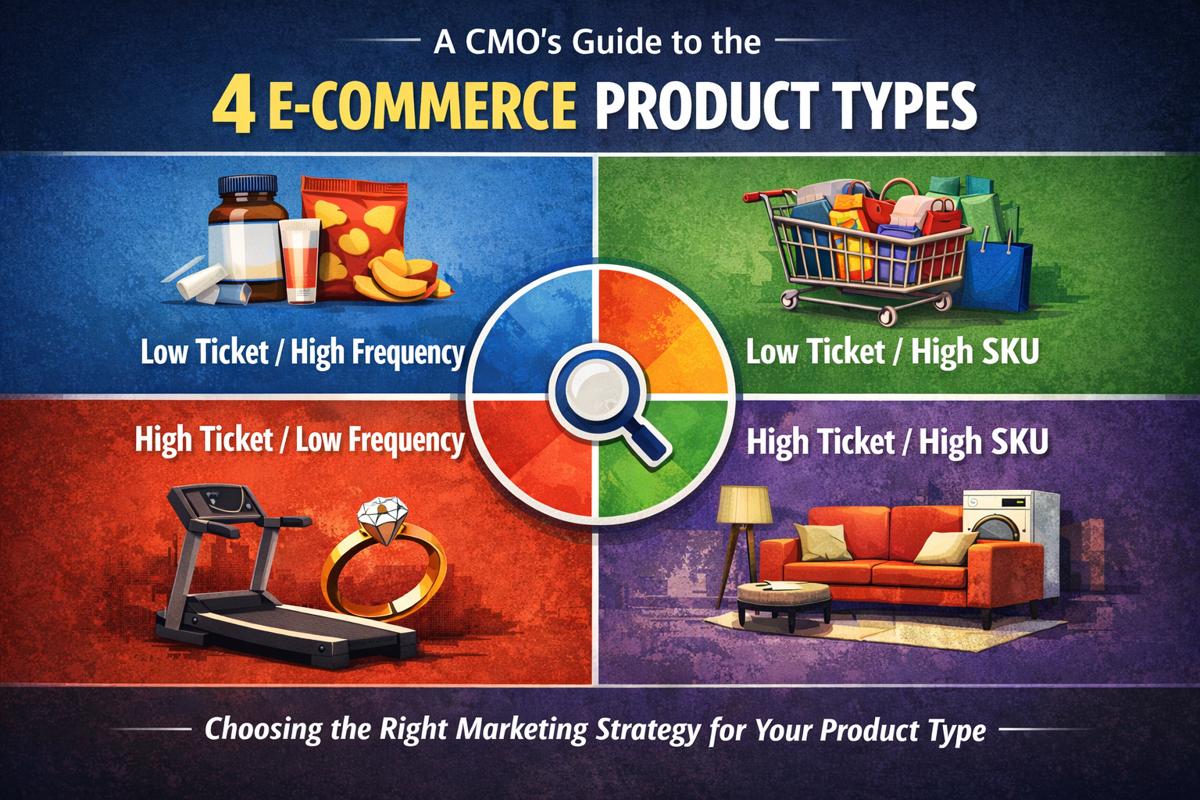
There are four core e-commerce product types. Each one creates a different growth bottleneck. Each one rewards a different strategy.
What Are the 4 E-commerce Product Types?
Every e-commerce brand fits primarily into one of these categories:
- Low ticket, high frequency, low SKU
- Low ticket, high frequency, high SKU
- High ticket, low frequency, low SKU
- High ticket, low frequency, high SKU
At first glance, these categories appear to be defined by price, purchase frequency, and SKU count. But those are just surface-level signals.
What we are actually trying to understand is buyer behavior.
- How often do customers purchase?
- How much risk do they feel when deciding?
- How many decisions must they make before buying?
- How much justification do they need to feel confident moving forward?
Those answers determine where growth is most likely to break down first, and where strategy should focus before teams start debating channels or tactics.
Why Product Type Determines Where Growth Breaks
Once the product type is clear, growth problems stop looking mysterious.
Most e-commerce teams operate as if all products should scale through the same funnel.
They push the same media mix and aim for the same performance benchmarks. They have the same expectations for speed and efficiency. And it creates friction.
Some brands push harder on acquisition when the real constraint is retention.
Others obsess over click-through rates when the issue is trust.
Many spend months refining ads when the breakdown is happening after the click.
Product type determines which of those problems shows up first.
Each category carries a predictable bottleneck.
When teams miss it, they end up optimizing around symptoms instead of addressing the underlying constraint.
Low Ticket, High Frequency, Low SKU
(Examples: snacks, supplements, beauty staples)
This category often looks like the easiest place to grow.
The price point is accessible, the purchase decision is fast, and customers are willing to buy again and again.
Brands like our client BrickHouse Nutrition operate here.
Because early traction comes quickly, teams often assume scale will follow naturally. Growth usually slows for a different reason.
The first breaking point for brands with low SKUs, low price products, and high purchase frequency is usually creative exhaustion.
Audiences don’t stop buying because the product stops working. They just stop paying attention because the message stops feeling new.
Over time, the same value proposition is shown to the same people in slightly different packaging. Performance flattens. Costs creep up.
The instinctive response is to adjust bids or hunt for new audiences.
Neither solves the real problem.
Winning brands in this category build systems that produce message variation at scale.
That typically includes:
- High-volume content pipelines rather than sporadic creative pushes
- Multiple storytelling angles around the same core benefit
- Retention strategies that increase purchase frequency and lifetime value
- Measurement that prioritizes long-term customer value over short-term efficiency
- In this quadrant, content velocity becomes a growth lever, not a branding exercise.
As SKU counts increase, a different challenge begins to surface.
Low Ticket, High Frequency, High SKU
(Examples: apparel, gardening, pet supplies)
In this category, demand is rarely the issue.
Customers are interested. They intend to buy and the price point does not slow them down.
But too much choice does.
As SKU counts grow, urgency turns into hesitation. Shoppers click around, compare similar products, and second-guess decisions. Ads still drive traffic, but conversion becomes uneven and harder to predict.
The first breaking point for brands with lots of SKUs, low price products, and high purchase frequency is usually decision friction.
Too many options without enough guidance forces customers to do the work themselves. When that happens, momentum drops after the initial click.
This is what we saw with our client Lauriebelles.
They had strong demand, healthy engagement, and a growing catalog. Paid media was doing its job at the top of the funnel, but performance flattened because customers were unsure where to start or which product was right for them.
Growth came from reducing choice anxiety and giving customers a clearer path forward.
That typically includes:
- SEO that captures category and use-case intent, not just individual product searches
- Merchandising that groups products by outcome, occasion, or need
- Content that teaches how to choose, not just what exists
- Paid media that introduces collections or solutions instead of single SKUs
Once brands solve for clarity, conversion stabilizes and paid acquisition becomes easier to scale.
When purchase frequency drops and price rises, the next constraint takes over.
High Ticket, Low Frequency, Low SKU
(Examples: fitness equipment, jewelry, electronics)
As price increases and purchase frequency drops, the buying mindset shifts.
Customers slow down. They research. They compare. They think about timing, alternatives, and whether the purchase is actually worth it.
Even with a small number of SKUs, the decision carries weight.
In this category, traffic alone does not create momentum.
The first breaking point for brands with higher price points, low purchase frequency, and limited SKUs is usually trust and justification.
Customers hesitate because they need confidence that the purchase is worth it.
This is what we saw with our client Derek Weaver Company.
Derek Weaver sells high-quality automotive tools with a focused product lineup. Demand was already strong, but heading into Q4 the priority was improving efficiency while continuing to grow revenue.
Growth came from reinforcing confidence across the entire buying journey.
They had strong intent-driven traffic and a focused product lineup, but performance depended on reinforcing buyer confidence, and growth came from reducing uncertainty and supporting the consideration process.
That typically includes:
- Authority-building content that reinforces expertise and credibility
- Clear category and product structure that supports comparison
- Proof through outcomes, reviews, and real-world use
- Paid media designed to support research and decision-making, not rush conversion
Once brands solve for trust and justification, hesitation drops and conversion becomes more predictable.
When high price points are paired with large SKU counts, complexity becomes the next constraint.
High Ticket, Low Frequency, High SKU
(Examples: furniture, appliances, home improvement)
This is where buying decisions become the most demanding.
Price is high. Purchases are infrequent. SKU counts are large. Customers take their time and expect to feel confident at every step.
In this category, interest alone is never enough.
The first breaking point for brands with high price points, low purchase frequency, and large SKU counts is usually complexity.
Customers are overwhelmed because evaluating all the options feels risky and becomes exhausting.
This is what we saw with our client Viesso.
Viesso sells modern, high-end furniture across a wide catalog. Shoppers arrived with intent, but conversion depended on how easily they could compare products, understand differences, and feel confident making a large purchase online.
Growth hinged on reducing cognitive load.
That typically includes:
- Guided selling experiences that help narrow choices and highlight meaningful differences
- Educational content that answers common questions before hesitation sets in
- Clear category and product organization that supports comparison
- Lifecycle nurture that supports longer decision cycles
Once brands make complex, high-risk decisions feel manageable, momentum returns and conversion becomes more predictable.
With all four product types mapped, the pattern behind stalled growth becomes easier to see.
If your growth feels stuck, the problem could be as simple as misdiagnosis.
If you want help identifying which product type you’re actually selling and which constraint matters right now, talk to a strategist.
Key Takeaways
- Ecommerce growth breaks in predictable ways based on product type, not channel mix.
- Low ticket, high frequency brands stall from creative exhaustion or decision friction.
- High ticket, low frequency brands stall from trust gaps or cognitive overload.
- Treating all products the same leads teams to optimize symptoms instead of constraints.
- Correctly identifying your quadrant makes strategic priorities obvious and actionable.
Frequently Asked Questions
What are the 4 types of e-commerce products?
E-commerce products generally fall into four categories based on price, purchase frequency, and SKU count: low ticket/high frequency/low SKU, low ticket/high frequency/high SKU, high ticket/low frequency/low SKU, and high ticket/low frequency/high SKU.
How do I identify which e-commerce product category my brand is in?
Evaluate your average order value, how often customers repurchase, how many SKUs you sell, and how much research customers do before buying. Buyer behavior is the strongest signal.
Why isn’t optimizing Meta or Google Ads enough to fix performance issues?
Paid channels amplify existing strengths and weaknesses. If the underlying issue is trust, choice overload, or content fatigue, channel optimization alone will not resolve it.
How often should CMOs reassess their e-commerce product type?
Anytime pricing changes, SKU count expands, buying behavior shifts, or growth begins to stall unexpectedly.



no replies