



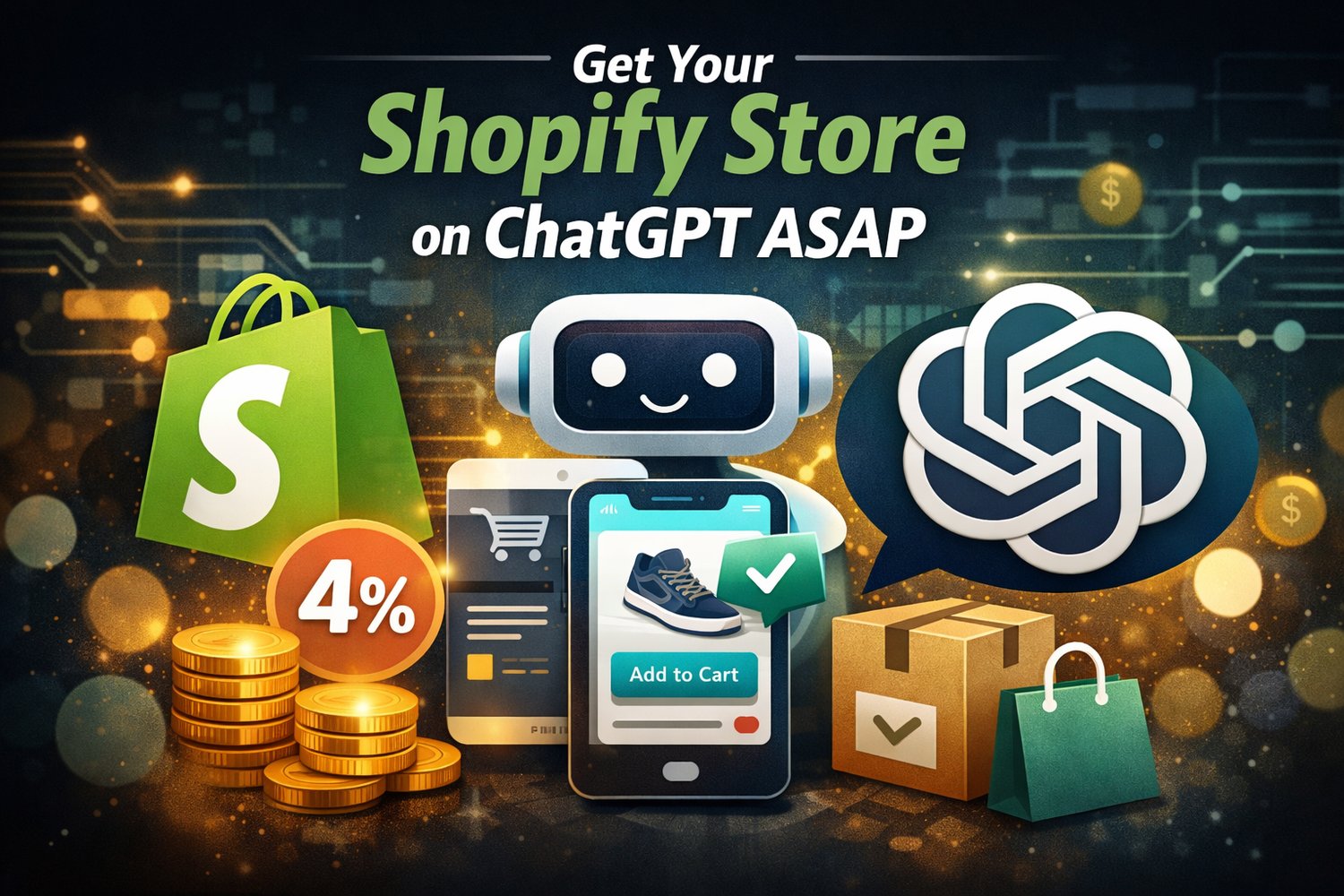
ChatGPT users can buy from Shopify stores right from their chat as of January 2026, in case you missed the announcement.
That means a customer can ask ChatGPT for advice, get a specific product recommendation, and then complete the purchase without ever going to your store. No Google search, no Amazon links, and no ads required (for now).
Lots of people are already pissed about the 4% transaction fee, especially since it stacks on top of Shopify’s standard 2.9%. But before everyone loses their mind, it’s worth zooming out for half a second.
Compared to most other ways you’re getting customers today, getting your products to show up on AI searches needs to be a big priority for most e-commerce brands.
Why OpenAI’s 4% cut of your Shopify sale shouldn’t bother you
The 4% fee sounds expensive until you compare it to what most brands spent to acquire new customers last year.
If you sell on Amazon, you’re paying 8 – 15% in referral fees before you spend a dollar on ads just to stay visible. In reality, most Amazon sellers are closer to 25–30% all-in once advertising is factored in.
Paid ads aren’t much better. Between Meta, Google, creative costs, and agency fees, plenty of brands are already spending 4 – 10% of revenue just to acquire a customer. And that’s assuming things are going well.
CAC rose across almost every industry last year.
Fashion, fitness, and health and wellness are our bread and butter at DP. In 2025, CAC climbed almost 9% for fashion brands, 17% for fitness brands, and 8% for health and wellness.
So even though an additional 4% feels like it’ll hurt merchants, the reality is that every other option for e-commerce brands is pay-to-play anyway. If you don’t want your Shopify store connected to ChatGPT, what other solution do you have?
Shopping on ChatGPT is old news
Shopify checkout on ChatGPT isn’t the beginning of shopping with generative AI. Buyers started moving to ChatGPT in early 2023 and more and more product research is happening inside LLMs every day.
Shoppers already use them to compare options, understand tradeoffs, and narrow choices before they ever go to Google or Amazon.
But most importantly, they trust the information they get from AI more than anything that shows up in a Google search.
Reports in 2025 showed shoppers in the US (plus Canada, UK, and Australia) trust AI results more than paid search results by a margin of 26%. (sources: https://www.askattest.com/our-research/consumer-adoption-of-ai-report-2025 and https://www.forbes.com/sites/rogerdooley/2025/03/10/ai-search-results-more-trusted-than-ads-what-cmos-need-to-know/)
The same report found 27% of shoppers use AI for at least half of their online searches. It’s even higher than that among Gen Z buyers. And men have more trust in AI (44%) than women (37%).
The only change is that now the research phase and the final purchase are happening in the same tab.
Answer Engine Optimization (AEO) will blow up in 2026
At the end of the day, you might hate the additional fees that come with connecting your Shopify store to ChatGPT’s in-app checkout, but this is the single biggest opportunity in digital marketing today, and early adopters in marketing are usually the biggest winners.
Here’s what Shopify store owners need to do to get ChatGPT to sell their products:
- Opt in.
It’s not automatic. You need to enable ChatGPT as a sales channel if you want your products to be eligible for in-chat checkout.
- Optimize your content for AI suggestions
AI doesn’t rank products the way Google does. It selects answers. That means clear positioning, clean product data, and content that actually explains who your product is for and why it’s the right choice.
We already know how LLMs make suggestions, and if anyone thinks OpenAI is not going to tweak responses to suggest products they get a piece of the action on…
Right now, recommendation pressure is low. Selection criteria are still loose. And brands that show up early have more room to influence how they’re positioned before this turns into another crowded, pay-to-win channel.
In-chat purchases on ChatGPT for Shopify stores is just the next step in the evolution of how customers buy online.
The biggest opportunity to make it a win for your brand was yesterday. The second biggest is now.
If you need help, talk to a strategist.
Key Takeaways
- ChatGPT now supports in-chat checkout for Shopify stores, allowing customers to research and buy without leaving the conversation.
- ChatGPT shopping introduces a new ecommerce acquisition channel that competes directly with Google search, Amazon listings, and paid ads.
- The 4% ChatGPT transaction fee is competitive with ecommerce customer acquisition costs, especially compared to Amazon referral fees and paid media spend.
- Product research is shifting toward AI tools, with more shoppers using large language models to compare options and make purchase decisions.
- Answer Engine Optimization (AEO) is becoming critical for ecommerce visibility, as AI systems choose products to recommend instead of ranking search results.
- Early adoption of ChatGPT checkout gives Shopify brands a visibility advantage before competition and monetization pressure increase.
Frequently Asked Questions
What is ChatGPT checkout for Shopify stores?
ChatGPT checkout allows customers to purchase products from eligible Shopify stores directly inside the ChatGPT interface without visiting the merchant’s website.
Do Shopify merchants have to opt in to ChatGPT checkout?
Yes. ChatGPT checkout is opt-in. Shopify merchants must enable ChatGPT as a sales channel to allow in-chat purchases.
How does ChatGPT compare to Amazon as an e-commerce channel?
ChatGPT offers lower transaction fees than most categories on Amazon and does not currently require paid advertising to appear in recommendations.
What is Answer Engine Optimization (AEO)?
AEO is the practice of structuring product data and content so AI systems can easily understand, evaluate, and recommend products in response to user questions.
Why does AI shopping matter for e-commerce brands?
Shoppers increasingly trust AI tools for product research, comparison, and decision-making. As checkout moves into those tools, brands must be present where decisions happen.
How should Shopify stores optimize for ChatGPT product recommendations?
Clear product positioning, accurate product data, simple language, and content that explains who the product is for and why it fits specific needs.
Will ChatGPT shopping remain organic?
Competition is expected to increase as adoption grows. Brands that participate early have more opportunity to influence how their products are surfaced.




no replies