



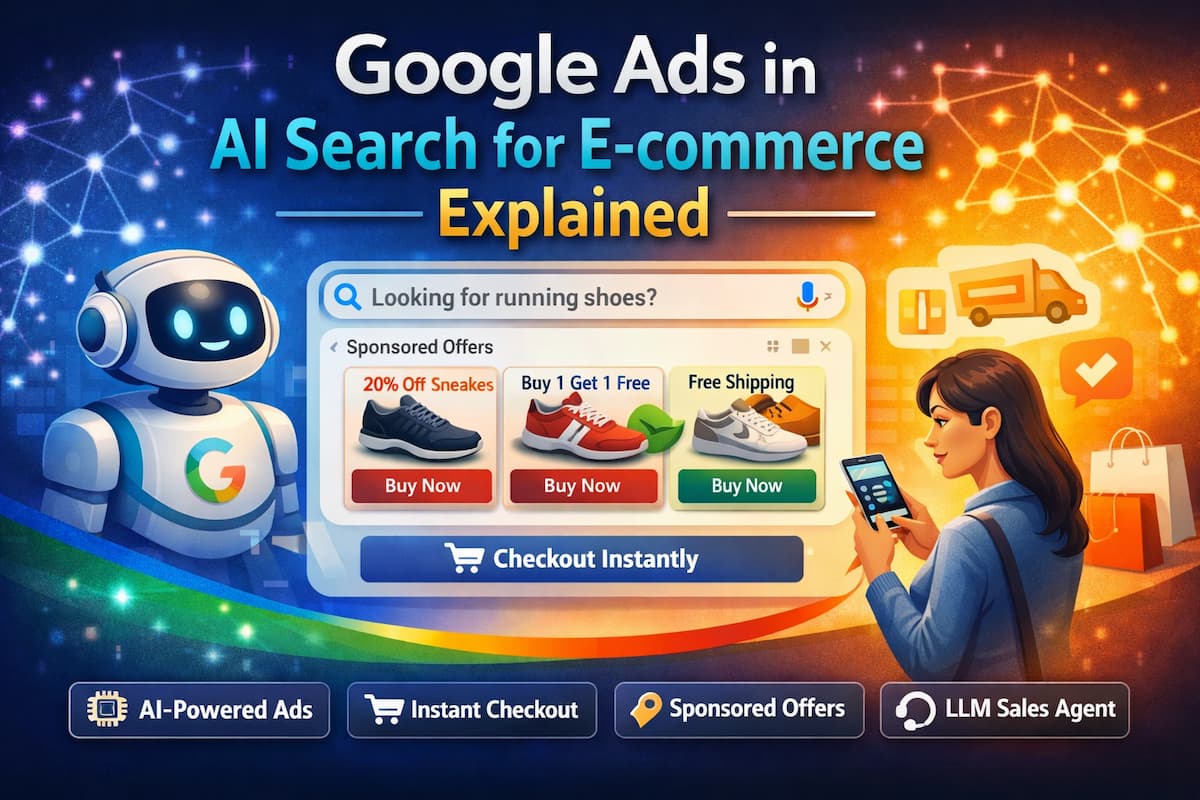
Google’s latest AI Mode update embeds ads, offers, and checkout inside AI-generated answers, and that change will break most of the assumptions brands still make about how Google Ads works.
It’s just a matter of time before Gemini is fully integrated into Google Ads, and (probably) ChatGPT into Bing Ad, so the time to begin optimizing for LLM-based sales is yesterday.
Users already trust LLMs more than traditional search results. The research phase of the buying journey has been shifting to AI for over a year, and now the transaction itself is moving there too.
The impact on buyer behavior won’t be subtle. And it won’t be slow.
What Google Actually Announced and Why It Matters to E-Commerce Advertisers
There are four important changes that explain where Google Ads is headed:
1. Ads Now Appear Inside AI Answers
Google is testing Sponsored Deals and Direct Offers that appear within AI Mode when Google detects strong purchase intent.
Users won’t need to scroll to see ads. The AI response itself serves the offer, integrated directly into the recommendation.
Google’s AI decides:
- When an offer should appear
- Which brands are eligible
- What incentive is most likely to close the sale
This is a complete departure from keyword bidding as we know it. Visibility will now depend (more than ever) on relevance, context, and confidence (along with spend).
2. Offers Are Becoming the Primary Ad Unit
In AI Mode, Google will prioritize offers over headlines or visuals.
The initial rollout of Sponsored Deals and Direct Offers is focused almost entirely on incentives:
- Discounts (first)
- Bundles (next)
- Free shipping and other value-based triggers (coming)
Instead of advertisers forcing promotions into the funnel, Google’s AI will decide when an offer is needed to move someone from research to purchase.
That’s a huge fundamental shift.
We used to think of offers as a conversion lever at the end of the funnel, but now they’re becoming part of the recommendation itself. If your brand doesn’t have a compelling, context-aware offer ready, the AI will simply recommend a different brand that does.
3. Checkout Is Moving Into the AI Layer
Google is also collapsing checkout into AI Mode through its new Universal Commerce Protocol.
That allows users to:
- Research a product in AI Mode
- See a recommendation
- Learn about an offer
- Check out immediately
Many of these purchases will likely happen without a buyer ever visiting your website. When the decision and the transaction all happen right in Google’s AI results,it dramatically shortens the funnel.
If your site, feeds, or checkout experience aren’t structured to support this, sure, you’ll lose site traffic. But much worse, you’ll be removed from the buying process entirely.
4. Google Is Giving Brands an AI Sales Agent
Google is also rolling out Business Agent, which functions like a virtual sales associate embedded directly in search.
It’s pre-purchase sales enablement, powered by AI, and trained on your data to:
- Answer questions about your product
- Explain the differences between options
- Give recommendations in your brand voice
- (Eventually) complete checkout inside the AI chat
Like a human sales rep, it’s not going to be effective unless it’s been given clear positioning, accurate information, and strong guidance on when a product is and isn’t a good fit.
Giving AI all the info it needs to confidently push your product is every e-commerce marketer’s new number one priority.
How to Show Up in AI -AI-Generated Recommendations
In AI search, the brand that makes the decision easiest is the brand that gets recommended.
Here’s how you make that happen:
Update your product pages for AI.
AI needs to understand who a product is for, when it makes sense to buy, and why it’s the right choice in a specific situation. Clear use cases, expectations, and tradeoffs will do that much better than feature lists and generic benefit copy.
Structure your feeds and Merchant Center data for context.
Go beyond titles and specs. Include common buyer questions, usage scenarios, compatible products, and alternatives. If Google’s AI can’t confidently explain your product, it won’t recommend it.
Build offers that AI will use to close decisions.
In AI Mode, offers will be decision accelerators. Discounts, bundles, and free shipping should map to buyer hesitation points rather instead of arbitrary sales calendars. If your offer meaningfully reduces friction, AI will push it.
Create teaching content AI and humans can learn from.
AI learns from what you publish. Brands that consistently explain how products are used, give industry insights, address objections, and show real outcomes give the model more and better material to work with. That content used to just drive traffic, but now it influences AI recommendations too.
The hardest change ecommerce marketers will have to make to succeed now that Ads are moving directly inside the AI interaction is going to be mindset.
You’re no longer optimizing for clicks. Now, your focus needs to be confidence.
If you’re not sure how prepared your brand is for ads and checkout moving into AI search, this is exactly the kind of shift we help teams think through.
If you want help adapting your paid media and content strategy for AI-driven purchases, talk to a strategist.
Key Takeaways
- Google is embedding ads, offers, and checkout directly into AI-generated answers.
- Visibility in Google Ads is shifting from keyword bidding to relevance, context, and confidence.
- Offers are becoming a primary part of the AI recommendation.
- Check-out moving into AI Mode removes the website visit from many buying journeys entirely.
- Brands that are easiest for AI to explain and recommend will win a disproportionate share.
- Product pages, feeds, and content now influence AI decisions as much as ad spend.
- The core optimization goal has shifted from clicks to confidence.
Frequently Asked Questions
How does Google AI Mode change Google Ads for e-commerce brands?
Google AI Mode embeds ads, offers, and checkout directly inside AI-generated answers, shifting paid search from keyword-driven clicks to AI-driven recommendations and transactions.
What are Sponsored Deals and Direct Offers in Google AI search?
Sponsored Deals and Direct Offers are AI-selected promotions shown inside Google’s AI responses when purchase intent is high, designed to help close sales during the research phase.
How will AI-generated ads impact e-commerce website traffic?
AI-generated ads and in-chat checkout will reduce some site traffic, but more importantly, they move the buying decision upstream, often before a site visit happens (if a site visit happens at all).
Will Google AI Mode replace traditional paid search campaigns?
Not immediately, but it changes how paid search works by prioritizing relevance, context, and offer strength over keyword bidding alone, and it will likely be popular quickly.
How do brands optimize for AI-driven Google Ads?
Brands optimize for AI-driven Google Ads by improving product page clarity, structuring Merchant Center data for context, and creating offers that reduce buyer hesitation.
What role do product feeds play in AI search and ads?
Product feeds provide the structured data Google’s AI uses to explain, compare, and confidently recommend products inside AI-generated responses.
Are product detail pages still important if checkout happens in AI search?
Yes. Product detail pages remain critical because AI uses them to understand product fit, use cases, and trustworthiness before recommending or enabling checkout.
How do offers work differently in AI search compared to traditional promotions?
In AI search, offers act as decision accelerators chosen contextually by the model, rather than blanket discounts scheduled around sales calendars.
Does SEO still matter when AI generates search answers?
Yes, but SEO shifts from keyword optimization to clarity, context, and content that helps AI confidently answer buyer questions.
What content helps brands show up in AI-generated recommendations?
Content that explains use cases, addresses objections, shows outcomes, and clarifies tradeoffs helps AI recommend a brand more often.
What’s the biggest change marketers need to make for AI search?
Marketers need to shift from optimizing for clicks to optimizing for confidence, clarity, and decision support within AI-driven buying experiences.




no replies