



Summary: How AI Changed Search and Attribution
Google Search still captures revenue, but it no longer creates demand the way it once did.
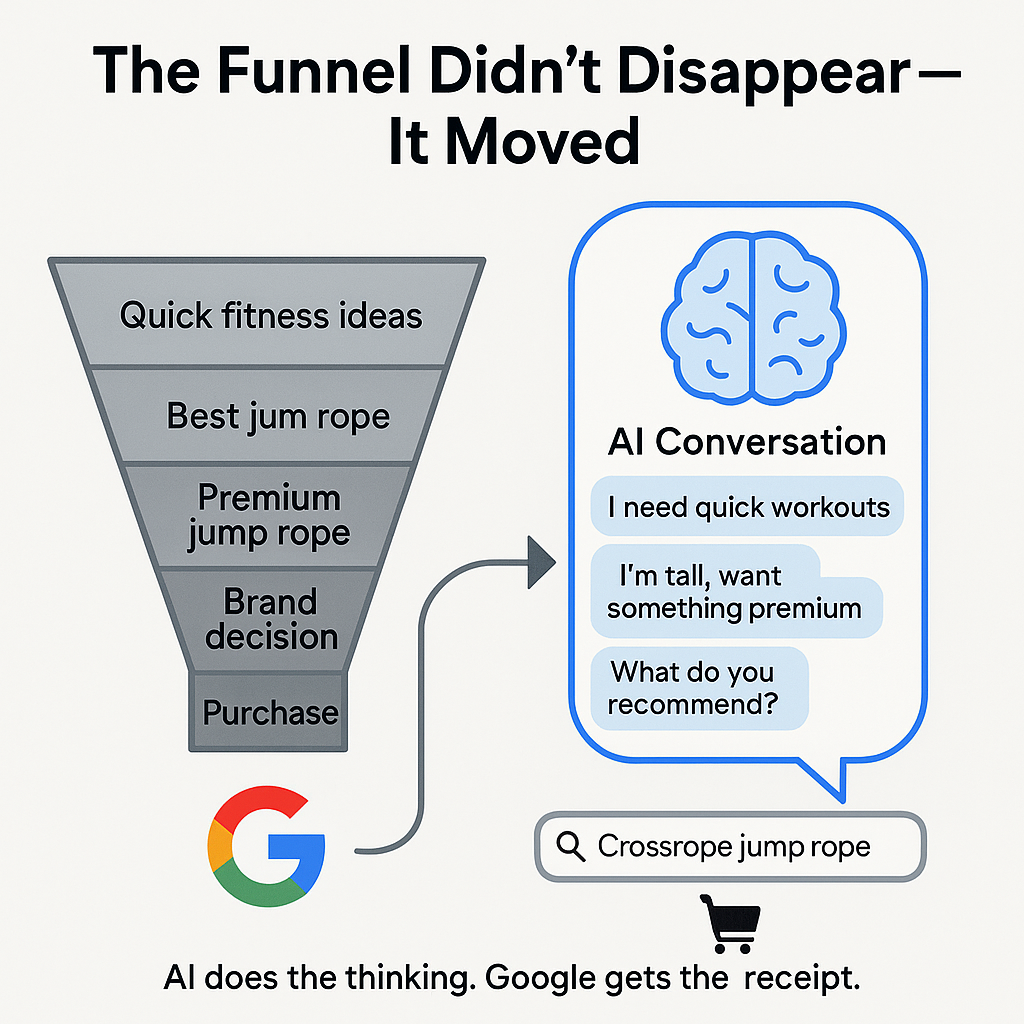
In 2025, AI tools like ChatGPT and Gemini took over discovery, research, and evaluation, forming buying decisions before users ever reach Search. As a result, Google’s revenue appears strong due to last-click attribution, even though demand was created upstream by AI, community discussion, and content.
In an AI-driven funnel, brands win by being easy for AI to understand, consistently described across trusted sources, and visible in places where AI models learn and validate recommendations.
Every day, Google’s reported revenue is becoming increasingly misattributed.
One of the biggest advantages of first-party, server-side tracking is the ability to see the full customer journey across the entire funnel, regardless of what individual platforms claim. Throughout 2025, this data revealed a major shift in how customers actually make buying decisions.
Google is capturing demand that it did not create.
The revenue is real. The credit is not. It’s like a Girl Scout claiming every box of cookies her parent sold at the office was the result of her sales skills.
How AI is Changing the Customer Journey in 2026
Google has been the primary selling tool for most brands for over a decade.
For years, it functioned as more than a transaction layer. Google was effectively the salesperson, the aisle, and the cash register all at once. Customers searched, evaluated options, compared brands, validated claims, and completed the purchase inside a single ecosystem.
But that’s not how it works anymore. AI has taken over the role of the salesperson.
Today, more and more of the research and the thinking that used to happen across multiple Google searches now happens upstream in a chat with Gemini or ChatGPT. Instead of piecing together answers across 9 different Chrome tabs, customers arrive at a Google Search with a buying decision already made.
In practical terms:
- AI handles discovery and evaluation
- Google handles the transaction
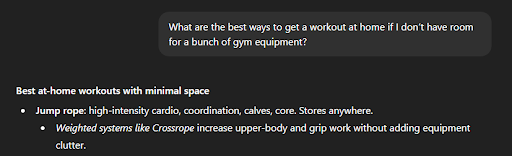
You used to type “fitness equipment” or “home exercise routines” into a Google search. But now you ask AI, “What are the best ways to get a workout at home if I don’t have room for a bunch of gym equipment?”
That’s why Search performance can look stable while incremental gains get harder to find. Google is doing a narrower job than it used to, and attribution models haven’t caught up.
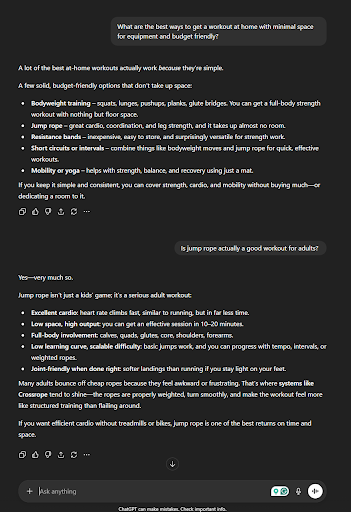
AI shapes the shortlist. Search inherits the outcome.
Search metrics still look healthy because:
- Brand demand still routes through Google
- High-intent users still convert
- Last-click attribution still assigns credit
So Search looks amazing until you get some context. When we look across the full funnel, Search is increasingly downstream of decisions formed elsewhere.
How do brands sell in an AI-driven funnel?
Not by “running ads on ChatGPT” (yet).
Not by chasing prompts or hacks.
Selling in AI environments is about being the brand AI recommends before a transaction ever exists.
That comes down to a few very specific actions.
1. Make Your Brand Easy for AI to Understand and Summarize
AI favors clarity over cleverness.
If an LLM can’t quickly explain:
- Who your product is for
- What problem does it solve
- Why is it different from alternatives
…it won’t recommend you.
This means:
- Clear, consistent positioning across your site
- Plain-language explanations of benefits and tradeoffs
- Content that answers real buyer questions, not just ranks for keywords
- If your differentiation requires a salesperson to explain, AI won’t do it for you.

2. Influence the Sources AI Pulls From
AI doesn’t “discover” brands on its own. It synthesizes patterns from sources it trusts.
Those sources are increasingly:
- Editorial content and expert reviews
- Creator commentary and long-form analysis
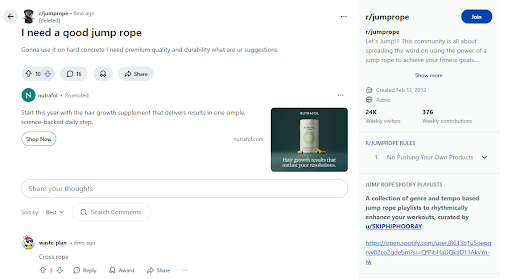
- Community discussions, especially on Reddit
- Consistent brand mentions across multiple independent domains
Reddit plays an outsized role because it captures unfiltered customer language LLMs train on, plus real comparisons, and practical advice. AI models frequently pull from these discussions to understand how real people talk about products, what objections come up, and which brands are repeatedly recommended.
3. Optimize for Shortlists
AI-driven funnels don’t surface ten blue links. They surface a shortlist.
To win a spot on that shortlist, brands need to control how they’re categorized and compared.
Practically, that means:
- Being explicit about when your product is the right choice (and when it isn’t)
- Clearly stating tradeoffs instead of hiding them
- Repeating the same positioning across your site, content, and third-party mentions
AI builds confidence through consistency. If your product is described the same way in reviews, Reddit threads, comparison articles, and your own site, it becomes easy for AI to summarize and recommend.

4. Use First-Party Data to Track What Actually Drives Demand
As AI reshapes the funnel, first-party, server-side data becomes non-negotiable.
It’s the only way to see:
- Which channels actually create demand
- What content influences decisions upstream
- How Search performance changes after upper-funnel investment
Platforms will continue to claim credit for conversions they touch. First-party data shows where influence really starts and where money should actually be allocated.
How Will AI Influence E-commerce in 2026?
Today, ChatGPT, Gemini, and similar tools influence buying decisions without handling checkout…
THAT WILL CHANGE!
Native checkout inside AI is inevitable. When it arrives, it will represent the biggest structural shift in e-commerce since people started buying things on their phones.
When discovery, evaluation, recommendation, and purchase collapse into a single AI-driven flow, the brands that win will be the ones that shaped the decision before the transaction ever existed.
Google will still matter.
Search will still convert.
The cash register will still ring.
But growth will belong to the brands that understand this shift early and invest where demand is actually created.
Key Takeaways
Google still captures demand, but it doesn’t create demand like it used to.
- AI now handles discovery, research, and evaluation before Search occurs.
- Search performance can look stable even as its influence declines.
- AI-driven funnels surface shortlists, not rankings.
- Brands win by being easy for AI to understand, summarize, and recommend.
- Reddit and community discussion increasingly shape AI recommendations.
- First-party data is the only reliable way to see what actually drives demand.
- Native AI checkout will compress the funnel and redefine e-commerce growth.
Frequently Asked Questions
Does Google Search still work for e-commerce?
Yes. Google Search still converts high-intent traffic effectively. Its role has shifted from persuasion to execution, capturing demand created elsewhere rather than generating it.
Why does Google’s revenue look strong if demand is shifting?
Because Search is often the final touchpoint. Last-click attribution assigns credit to Google even when the decision was formed earlier through AI, video, social, or community content.
How is ChatGPT changing how customers shop?
ChatGPT and similar tools compress research, comparison, and evaluation into a single interaction. Customers arrive at Search with preferences and decisions already formed.
How do brands sell on ChatGPT today?
Brands sell on ChatGPT indirectly by being consistently referenced across trusted sources: authoritative content, creator coverage, reviews, and community discussions like Reddit.
Does SEO still matter in an AI-driven funnel?
Yes, but not in the traditional sense. Clarity, consistency, and positioning matter more than keyword rankings. AI favors brands it can easily explain and compare.
Why is Reddit important for AI-driven customer research?
Reddit captures real customer language, honest comparisons, and practical advice. AI models use these discussions to understand objections, preferences, and brand sentiment.
Will customers buy directly inside AI tools?
Yes. Native checkout inside AI is inevitable. When it launches at scale, it will represent the biggest ecommerce shift since mobile shopping.
How should brands measure success in an AI-driven funnel?
By using first-party, server-side data to track which channels create demand upstream, not just which platforms record conversions.





no replies