


A brand gets 100 creator videos and loads them all into one ad set. Two get spend.
Then the creator program takes the blame.
The structure was the problem the whole time. We see it constantly on Trybe accounts, and it hits anyone running UGC at volume on Meta.
Here’s how to set up Meta so every creator video gets a fair shot.
TL;DR
- Meta leans on the creative itself to find buyers, so more distinct UGC means more chances to win
- Dumping dozens of videos into one ad set lets one or two eat the budget
- Split campaigns by product, group ad sets by angle, and give top creators their own ad sets
- Build approved videos into ads at least twice a week
- Read results from store data, because platform dashboards disagree
Why Does UGC Outperform Studio Creative on Meta?
Meta’s delivery now reads the creative to decide who sees it. Audience settings carry less weight than they used to, which means your ad is doing the targeting.
That changes the math on creative volume. Every distinct video is another shot at a pocket of buyers you could never have targeted by hand.
Creator video wins a lot of those shots, and volume is what gives it the chance. Natural, phone-shot UGC looks like the rest of the feed, so people don’t scroll past it the way they do with studio ads.
On our programs, authentic beats polished almost every time. Routine videos and comparison angles have been some of the strongest performers we’ve run.
What Happens When You Put 50 UGC Videos in One Ad Set?
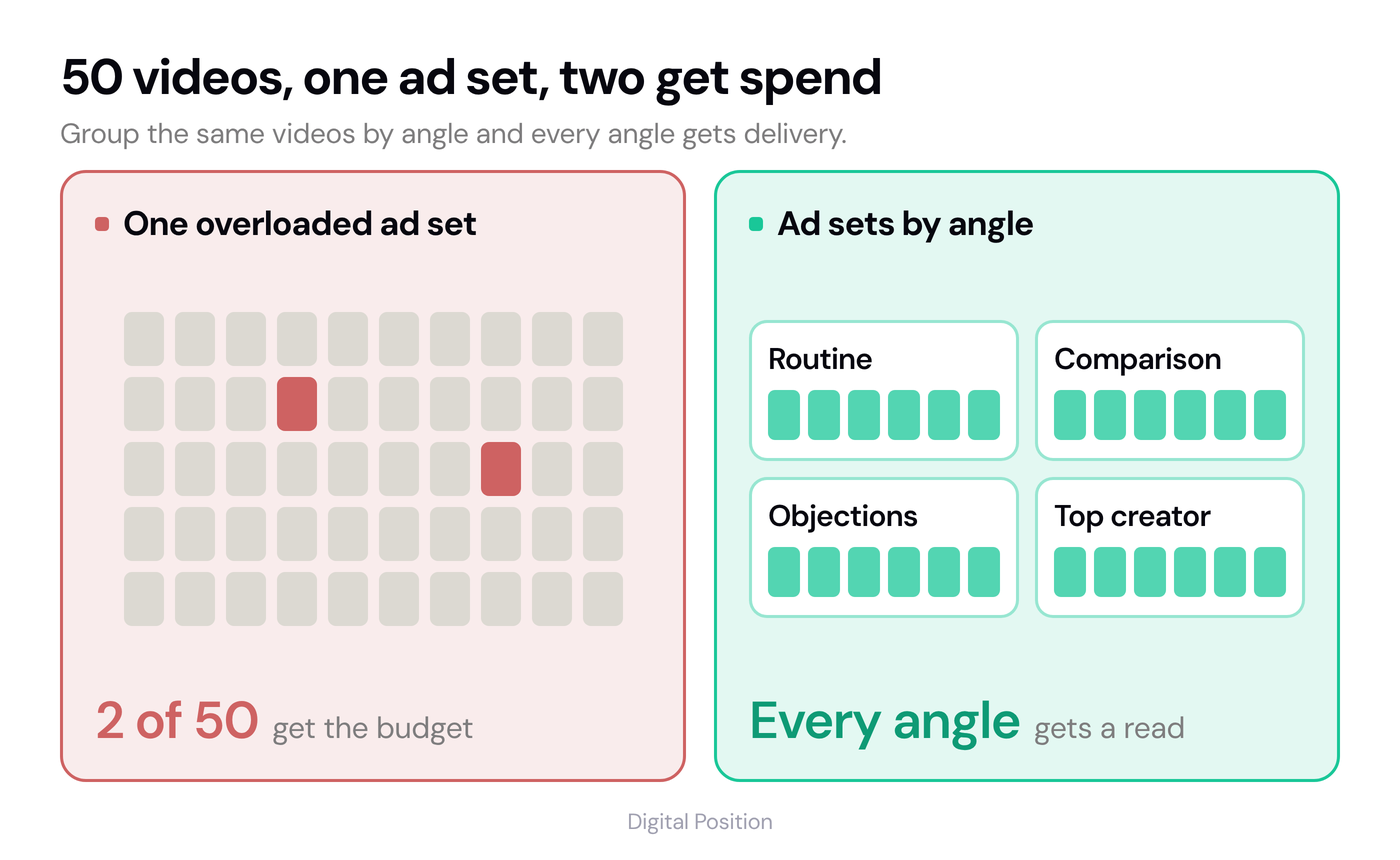
Meta finds an early winner and pushes the budget there. Everything else starves.
Open the ad library for a lot of high-volume brands and you’ll see it. Rows of creator ads with low impression counts. Two are winning, and the rest never got a real test.
One agency playbook that ranks for this topic describes brands launching a dozen UGC videos into a single Advantage+ campaign on day one, watching one ad take the budget, and deciding UGC doesn’t scale. At Trybe volume, the same mistake gets much bigger. A supplement brand we manage takes in 100 to 200 submissions a week.
Low impression counts are the tell. When most of a brand’s creator ads sit at low impressions while a couple carry everything, the account is choosing winners before most videos ever get a read.
The damage shows up in two places. Creators stop submitting when their videos never run. And you never learn which angles work, because most of them never got delivery.
If most of your creator ads show low impressions, the problem is the structure, not the creators.
How Should You Structure Campaigns for High-Volume UGC?
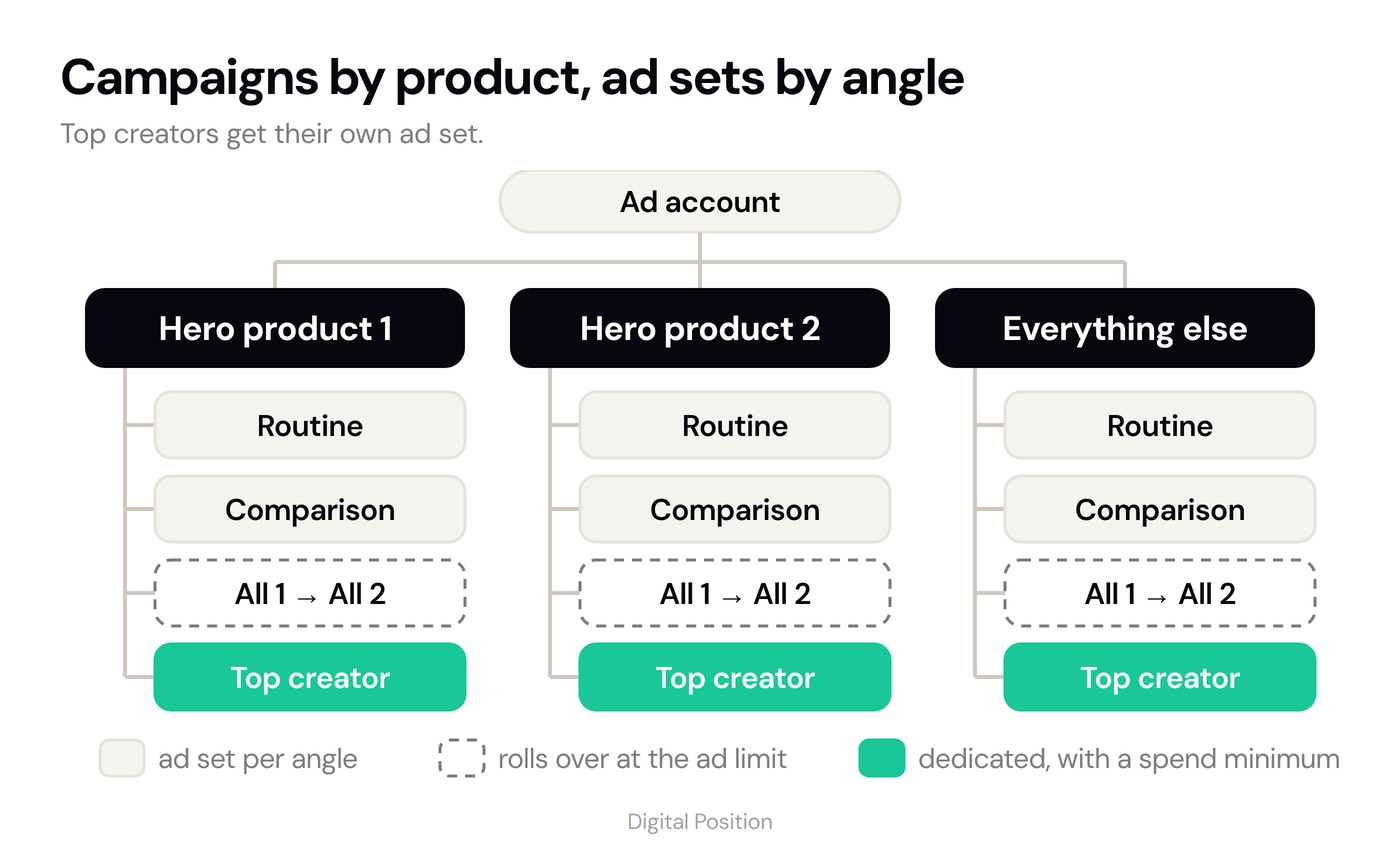
The fix is boring, and it works.
1. Split Campaigns by Product
Landing pages and ad copy change by product, so each product or product family gets its own prospecting campaign. One supplement brand we run has a campaign for each of its two hero products and a third for everything else.
2. Group Ad Sets by Angle
Inside each product, group videos by creative angle and keep the angle names identical everywhere, from the creator brief to the ad set to the ad name. An angle like “creatine doesn’t make you bulky” should read the same in all three places. That naming discipline is what lets you read results by angle later instead of guessing.
3. Roll Into New Ad Sets at the Limit
When an ad set hits its ad limit, open a new one with a sequential name (Product All 1, Product All 2). Cramming more into a full ad set is how you end up back at the 50-video problem.
4. Give Top Creators Their Own Ad Set
High-producing creators get a dedicated ad set with a spend minimum, so their videos get enough delivery to be judged fairly. At maturity, we aim for 5 to 10 ads per active creator.
Partnership Ads vs. Whitelisting: Which Should You Run?
Run partnership ads whenever you can.
Meta folded what it used to call branded content ads into partnership ads. The creator’s handle and yours both show in the ad header, and the ad runs from Ads Manager like anything else.
Whitelisting is the older term for running ads through a creator’s identity. Partnership ads are Meta’s official format for it, with permissions the creator controls.
Permissions come in two flavors. Content-level permission lets you boost a specific post once the creator shares an ad code. Account-level permission lets you run ads from the creator’s handle, including from posts that tag you.
On Trybe, approved videos build as partnership ads in one click. If the partnership option is available, we choose the creator’s identity. If it isn’t, the ad runs from the brand page.
How Often Should You Build and Refresh Creator Ads?
Build at least twice a week, until nothing approved sits unpublished.
Work one product at a time. Filter to unpublished videos, group them by angle, pick the right campaign and ad set, match the copy and landing page to the product, then build. An approved video that never runs is money spent for nothing. The creator who made it notices, too.
The brief needs the same rhythm. Refresh it every two weeks with 3 to 5 live angles, and send one Content Idea of the Week built on whatever is winning. A single idea gets made, and a list of five gets ignored. Pair it with a weekly board of 5 to 7 fresh UGC ads from your category, shared as inspiration rather than a script, and shout out the 3 or so creators whose videos stood out that week.
If you’re still weighing the model itself, here’s what to know about Trybe UGC before you launch.
How to Use UGC in Meta Retargeting
Warm audiences already know your product, so retargeting creative should answer whatever is still making them hesitate.
The creator angles built for that job:
- Objection handling, on taste, price, or whether it’s worth the money
- Social proof, the “I kept seeing this everywhere” angle
- Routine integration, showing the product inside a real day
Brief these on purpose, the same way you brief prospecting angles, with a reference example and a clear product to feature. Label them with the exact naming you use for prospecting. Then read retargeting results by angle too. When an objection-handling video wins with warm audiences, that’s next week’s Content Idea of the Week.
How to Read UGC Performance When the Numbers Disagree
Trybe and Meta will report different numbers. Expect it.
Trybe uses server-side last-click attribution and runs more conservative than Meta’s own reporting. We report true results from store data, cross-check creative in our own analytics, and treat in-platform ROAS as directional. A Trybe number that looks low next to Meta usually reflects stricter attribution.
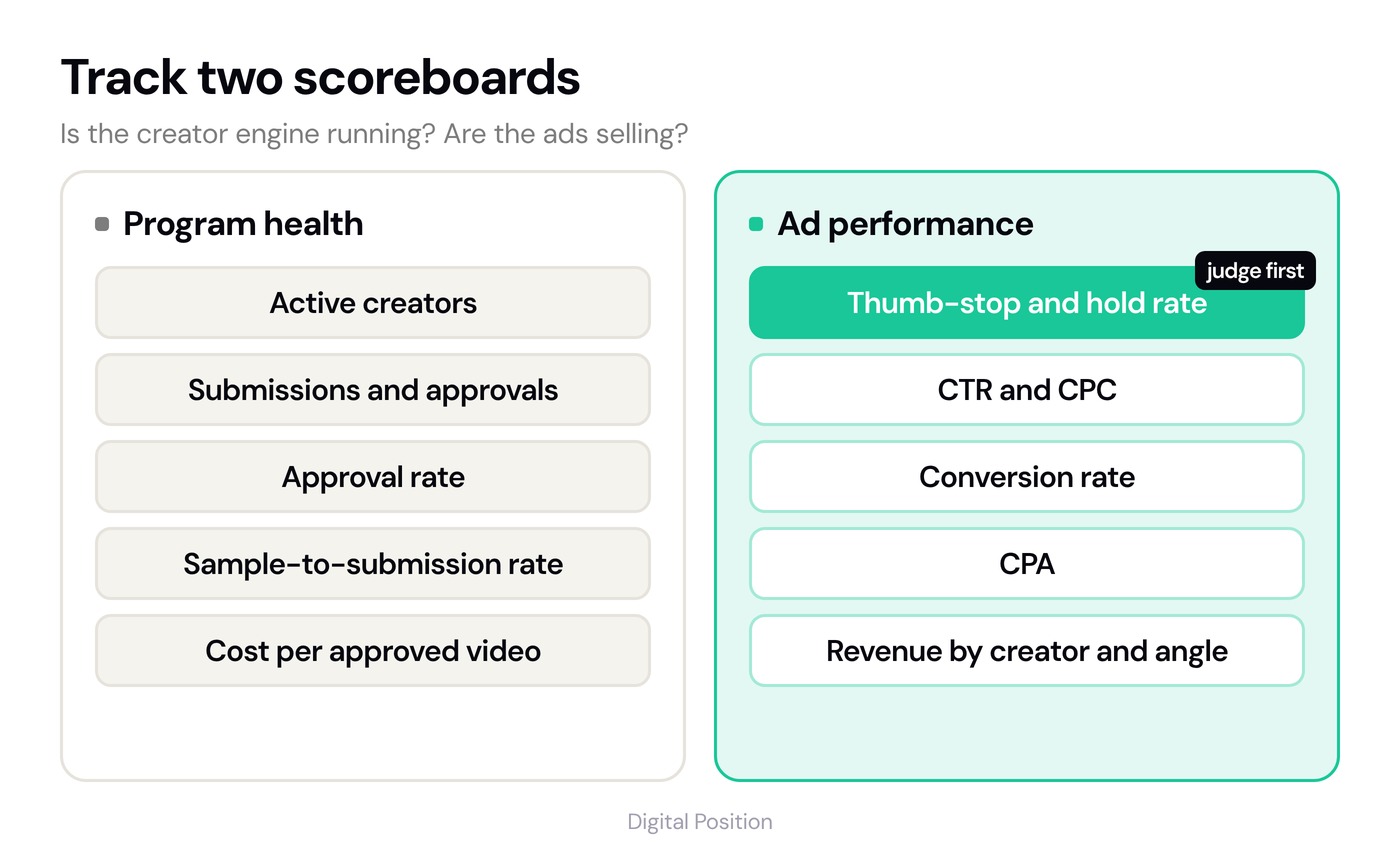
Track two scoreboards separately. Program health tells you whether the engine is running: active creators, submissions and approvals per week, approval rate, sample-to-submission rate, and cost per approved video. On the ad side, watch thumb-stop and hold rate, CTR and CPC, conversion rate, CPA, and revenue by creator and angle.
Judge creator videos on thumb-stop and hold rate before ROAS. A weak opening kills a good product before the algorithm ever finds it a buyer.
Scale only once the first cohort hits its baseline and a few angles keep repeating as winners. Then move four levers together: the Trybe budget, the Meta budget, more volume on the winning angles, and bigger deals for your top creators.
Why Your Creator Program and Ad Account Need One Owner
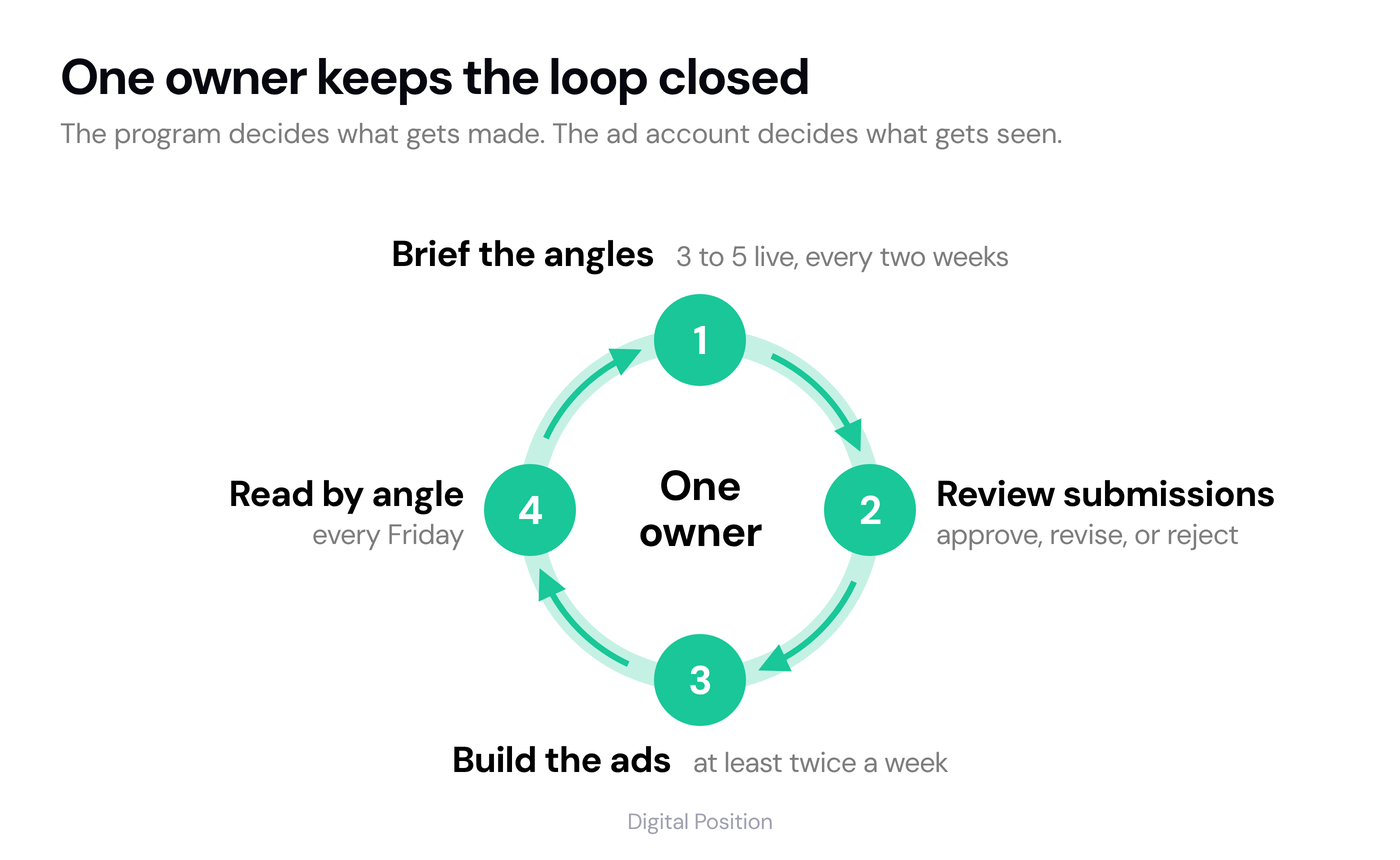
The creator program decides what gets made, and the ad account decides what gets seen.
When two different teams own those, the loop breaks. Winners never make it back into the brief. Approved videos sit unbuilt for weeks. Creators drift toward what’s easy to film instead of what sells.
That’s why we only run Trybe alongside Meta management. Every Friday, performance data decides which angles we add and which we cut, and creators get briefed on what’s selling.
If your creator videos aren’t getting spend, talk to us about Trybe program management, or speak with a strategist on our team.
Key Takeaways
- Creator videos win or lose inside the ad account
- One overloaded ad set means one or two videos get spend and the rest never get tested
- Campaigns by product, ad sets by angle, and dedicated ad sets for top creators
- Build at least twice a week and leave nothing approved unpublished
- Store data is the source of truth when Trybe and Meta disagree
Frequently Asked Questions
How Many UGC Ads Should Be in One Ad Set?
Fewer than most brands load. Group ads by product and angle, and open a new ad set when one hits its limit.
What Are Meta Partnership Ads?
Partnership ads run from Ads Manager with both the creator’s and the brand’s handles in the header. Meta renamed branded content ads to partnership ads.
Is Whitelisting the Same as Partnership Ads?
Whitelisting is the older term for running ads through a creator’s identity. Partnership ads are Meta’s official format for it.
How Often Should I Refresh UGC Creative?
Build new approved videos into ads at least twice a week, and refresh the creator brief every two weeks with 3 to 5 live angles.
Why Does Trybe Report Fewer Sales Than Meta?
Trybe uses server-side last-click attribution, which is more conservative than Meta’s reporting. Use store data as the source of truth.



no replies